
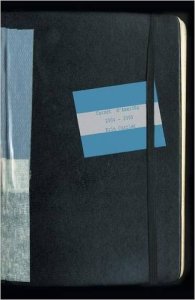
Carnet d’AmeriKa, Erin Currier (2016, CSF Publishing)
“To be human is to transform; to be human is to name, then name anew. I must remember the inseparable nature of word and action.” Erin Currier, November 6th, 2004
In a sense this passage became one of Erin Currier’s self-fulfilling mantras, its ethos guiding the trajectory of her life and art. As an insatiable seeker, with the ambulatory zeal of a flâneur, Currier has literally “walked the walk” in collecting trash from different countries around the world. Her epic scavenger hunt, keyed to alchemy and renewal, has given rise to a dynamic body of artwork, which continues to grow and attract followers and collectors worldwide.
Carnet d’AmeriKa, the second of her travel diaries to be published (the first, Carnet d’Asie, came out in 2013), is a visceral blend of sketches, observations, musings and collages, spanning a period in Latin America (2004-2005).
Immersion into the cultures she visits, particularly the fringes and non-touristic-realities, is a central theme in Currier’s writings, and is reflected with nuance, compassion, and unflagging curiosity. In one entry she writes: “I am back in Buenos Aires and love is born anew. This time, I have tried to arrive with empty eyes and a mind that forgets.” Indeed, a fresh-visioned, beginner-minded way of seeing, coupled with astute political awareness, permeates the diary. Demonstrating a collagist’s schismatic flair, Currier moves between topics with fluency and ease. The serenity she experiences in hanging out laundry on a rooftop, tangentially extends to Frida Kahlo’s painting “My Dress Hangs There,” and by literary proxy to Remedios the Beauty, the woman from Marquez’s One Hundred Years of Solitude whose common task of laundry turned into a sky-sailing departure.
Christmas Eve in Granada, replete with a siege of fireworks and ceremony; tenderly observed moments of children sliding down slides into “the stronger gravity of their mother’s arms;” the subterranean allure and teeming democracy of a metro station; arriving in Buenos Aires at 4am—“melancholy, spirited, and appealing as ever in the junk-sick dawn.” These and other textual snapshots make for a compelling and inclusive read.
Berthe Morisot, the Impressionist painter, wanted to capture the fugitive effects of light on nature. Carnet d’AmeriKA left me with a sense that Currier is attempting to capture the fugitive motion that powers and lives inside people, a sort of spiritual kinesthesia. Her words, like her artwork, insist upon dignity, grace and nobility as the innate riches of our human inheritance.
(To view Erin Currier’s artwork, visit her website.)

 John Biscello