A father’s pocket,
containing secret petals—
the meaning of love.


We are here, but briefly,
shadows of candle-light
dancing between dust and choir,
day and night,
so consider today
a good day
to begin, or to continue
unwrapping yourself,
and giving you to you as a gift,
your soul rightfully tagged
as both receiver and sender,
in what constitutes
a wild embracing and radical fusion
of the old and the new, in that place
where wonder meets faith,
and the fragile birds of gospel
sing sweetly and achingly
of hearts broken open
to pour light,
to inherit the tenderest
of lost and lasting claims.

1.
The hem of her dress had caught his eye.
Yours was an eye waiting to be caught, she’d say, later, much later, a drizzle of girlishness in her voice.
The dress was a form-fitting red dress and the hem was fringed. He also noticed her throat, how it was white and bare and asking. But he only noticed her throat in relation to the hem of her dress. He would not have seen the throat otherwise. Later, much later, he would tell her how the fringed hem had produced soft strange visions.
Strange how, she inquired, but he couldn’t say strange how, not because he didn’t want to say, he just couldn’t say. His grotto of silence caused her to throw her head back and laugh, exposing the taut symmetry of her throat. Lovely as it was, it did not inspire visions, and for a long time afterwards he’d wonder why.
2.
It was his friend Mitch who had invited him to the party. Mitch was always inviting him to parties. Mitch seemed to know where and when all the parties in town were taking place. There’s going to be a great party on Saturday night at so-and-so’s. Great emphasized with zip and crackle. Or: There’s going to be a party on Tuesday night at so-and-so’s. It could be good. Hopefulness flagged by doubt. Sometimes it would be like that. His response was pretty much always the same: Sounds like fun.
3.
He had found his corner, his niche, and staked himself there, half his body turned toward the wall. Around him the crowd, the fractious winged patter, generating circles within circles. He grew dizzy, listening. And watching. None of it seemed to have anything to do with him. He couldn’t locate himself, spatially or otherwise, until the fringed hem of the red dress appeared as revelation cutting through soporific haze. He could suddenly place himself within the context of his surroundings, and his unfulfilled impulse, he would remember later, much later, was to touch the hem, or tug on it, if she would have been closer.
If I would have been closer, she reminded him, and lightly grazed the back of his hand.
4.
When he awoke he saw Mitch’s face looming above him, a distorted satellite with liquid eyes. At first he felt nothing, and then he felt cold and nauseous when Mitch helped him to his feet. The room righted itself. He thought he would throw up but didn’t.
What happened, he asked Mitch.
What happened is I don’t know what happened. One minute I see you standing in the corner, the next minute you’re on the floor.
Mitch grinned, clapping his shoulder.
Too much to drink?
I haven’t been drinking, he said, and realized his lips were bone-dry. Then he remembered. And scanned the room.
Where is she?
Where is who?
The woman in the red dress.
5.
When he gets home, he goes into the bathroom, opens the medicine cabinet, takes out a bottle of Tylenol, taps two into his palm, chucks them to the back of his throat, turns on the faucet which runs cold water into his cupped palm, washes the Tylenol down. Pink and black has settled over the puffy bags under his eyes. He tilts his heads back to examine his throat, noting the sinewy curves, which his index finger then traces, producing a shiver. He squints inwardly, thinking about the party he had been to earlier, much earlier, and what if he hadn’t gone? He looks into the mirror one more time, then turns off the bathroom light, and goes to bed wondering what it would have been like if he had not been at the party.
6.
In exactly fourteen days, his friend Mitch will call him up and say—There’s going to be a fucking great party this Saturday at so-and-so’s. Fucking great would be laced with zip and crackle. He would respond—Sounds like fun.
At that party, on that Saturday, he would see the fringed hem of a red dress come to him from across the room. For a long while he would remain perfectly still, afraid that any sudden movement would destroy everything, and eventually he drifted in the direction of the woman in the red dress, and her voice, like a white-ringed wave, broke over him in foamy recognition—You seem … do I know you?
And later, much later, he would tell her the story about a story in which two people meet, again, the first time, returning.
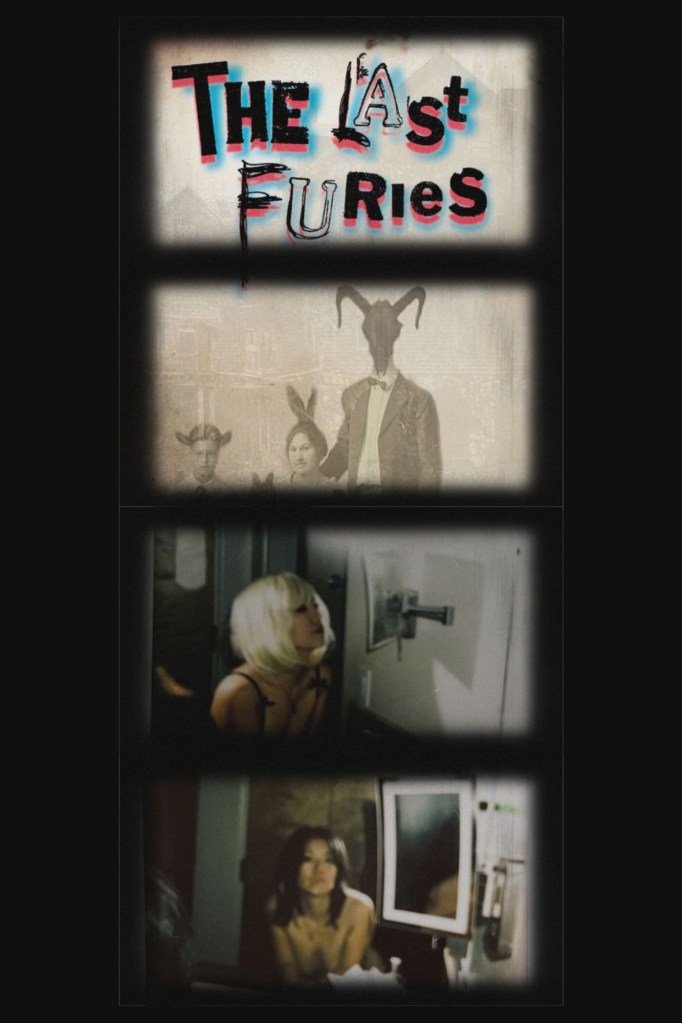
Two upcoming events in Los Angeles for The Last Furies. The weekend literary mini-tour will include:
Sat., January 17th at 7pm at Reverie Bookstand (1519 W. Sunset Blvd)
Sun., January 18th at 2pm at Lucky 13 Micro-Gallery (391 Coronado Ave., Long Beach)
Both events will comprise a reading/book-signing (copies of the Furies will be available for purchase), and the cover artist of the novel, Heather Ross, will be exhibiting her work and joining me for salon-style discussions on storytelling, visual art, and the innovative spirit of indie creation.
If you’re in the L.A. area, come on down and join us for the celebration!

He often reflected, while writing, upon himself, writing: reflecting another. Who he was, who he was not. Absence and presence locked in intimate simultaneity, a cogent pairing. Who is this Other, writing? And does he reflect upon me? Why do I perceive him as if through a thin rippling sheet of plasma—he appears to me as a soluble phantom with whom I have nothing in common, yet to whom I feel ultimately bonded.
I feel as if: I am writing, therefore the Writer, and the presence of the Other, let’s say above me and off to the left (to constellate a fixed point of orientation), affirms this notion by stating—He is the Writer, writing … which, instead of validating my existence, strikes a contrary note: he is the Writer, not me, he, this thing. And if I cast these words at Him, nothing, not a word, and the length and girth of silence stuns me into understanding: If not written, He would not exist.
So who the hell is writing, who is responsible for creation, His and the pages? Also, how could he be writing and see Himself, not Himself, writing Himself, the written, and reflect upon it in such a way. Something happening, something not happening. Something there, something not there. A person referring to a person, yet no one is being referred to—there is no one to do the referring.
And so these words, from where do they come? Thin air? The interstices between being and not-being? Are these the words of the dead, the words of the unborn, the words of the dreamed, the undreamed?
A portrait of a writer sitting at his desk, pen in hand, suspended between air and contact with the page, and he is being watched, therefore defined, in a narrative by the watcher (who is also the voice). In other words: A writer, sitting at his desk, pen in hand, suspended between air and contact with the page, and he starts to write—A writer, sitting at his desk, pen in hand, suspended between air and contact with the page … and the story will end, as it begins.
That’s him , yeah. That’s right, every day, from late morning to dusk, he sits on that bench and waits for her. I don’t know who she was. His love who left him. Or died. Disappeared. There are all kinds of stories. No one knows the truth. Except him. He comes every day with a brown bag lunch. A sandwich and a thermos filled with … I think filled with coffee. He eats the sandwich slowly. So slowly … its hurts me to watch him eating that sandwich. I can feel his loneliness in the way he eats … know what I mean? Maybe it’s just me. Because I see him every day. Yeah, I sit on this bench, opposite his. We’ve never spoken. I’m pretty sure he doesn’t know I exist. I come here for my own reasons. Not that a girl left me or died or disappeared or anything like that. My reasons are … I don’t know, I guess you’d call them non-specific. Look, look, he’s taking out the sandwich. Watch how he unwraps it. Slowly, methodically. Like something fragile. Something about that … it gets to me. Do you understand? And the way he feeds pieces of bread to the pigeons. It’s just … watch, watch. Nothing? Really? Maybe it’s just me. Maybe because I see him every day. Maybe because … I don’t know. And the girl. I always think about her. What if one day she shows up? What would it be like if I come here and I don’t see the old man, if there is no sandwich and no thermos, no slow careful eating … what if I didn’t have this hope and loneliness to share with the old man? If she came back … what would become of us?
Being a cartoon is not all it’s cracked up to be. Don’t get me wrong, when I first made the conversion from human to cartoon, I considered myself the luckiest sonofagun on the face of the earth. All my human frailties and limitations were gone, and I thought of myself as fully liberated. I could throw myself in front of a steam roller (which I often did, just for kicks), get flattened, then blow into my thumb and re-inflate myself. I jumped off skyscrapers and walked away, unscathed. I was able to execute taffy-esque contortions with my cooperative cartoon body. I was no longer bound by the laws that governed the physical human world. Free, right? Not exactly.
Yes, I could vault from a tall building fully confident that death would not claim me, yet a small mysterious something inside me died after those falls. And what I noticed, as those tiny deaths accumulated, sort of like kinks and crimps in my cartoon-gummy stomach—I was driven to do more and more outrageous things. That is, my need for cartoon-dramatic effects and actions intensified. I had to fiercely assert my cartoonishness, lest that growing fear—am I really as impervious as I think am?—would sink its claws into me and not let go.
For those who care to know—my cartoon alter-ego is Willis the Wolf. Who, exactly, was I before I became a cartoon? That’s a good question. I have forgotten my human name, and most of my human memories. There are some scattered bits and pieces, fragments wrapped in haze. It’s sort of like seeing a disconnected run of film clips through a foggy lens. I would like to say that I don’t miss my name or memories at all, but that is not true. There is a nagging curiosity, an under-the-skin splinter that subtly announces it presence. If that splinter could talk, what I might say: As long as I am here, under your skin, you will wonder who you are and what you’ve been missing as a human being.
Lately, the urge has grown stronger for me to abandon my cartoon life, to shed Willis’s thick and heavy fur. But how? How to get back to my pre-cartoon form?
I don’t know the answer, but I do know that I’ve started acting differently. I no longer throw myself in front of steamrollers, or off of skyscrapers. I no longer seek out accidents or commit frivolous “suicides.” I have started acting as I imagined I would if I were human. With concern and regard for my body and well-being. A respectful nod to mortality, and a toning-down of the dramatic and exaggerated. While I don’t know if the new choices I’m making will help me get back to my original human form, the other morning, when looking in the mirror, I noticed that I had shed a significant amount of fur. Enough that the bright pink flesh beneath was exposed.
He notices the dark red lipstick on the rim of the glass, displaying a half-moon smudge. For an instant, his vision moves beyond the glass and settles on the inner lapel of the jacket she’s wearing, comparing its brighter red to that of the lipstick.
She turns her bare slender fingers, the index and middle one, around the stem of the glass, slowly rotating it. The movement, a subtle one, magnetizes his attention to her fingernail polish: a caramelized burgundy.
She releases the stem, retracting her fingers, the outside of her hand grazing the edge of the table as her hand withdraws. The table is covered by a white linen tablecloth. There is a votive candle, unlit, inside of a crystal fixture, which has textured grooves cut vertically into its design. Her hand is placed palm down at almost exactly the midway point between the candle and the glass. She inverts the fingers on her other hand, slightly, as she raises her hand to mouth and clears her throat, hiccupping a cough.
He scratches the underside of his chin, using the edge of his thumbnail. She notices the kernels of fresh stubble darkening his chin. When he rests his hands, he folds them neatly, directly in front of where his abdomen and the table meet, then quickly disengages one hand from the other and coughs dryly into a cupped palm.
The waiter comes over. She acknowledges the waiter with a smile. He acknowledges the waiter with a slight nod. The waiter asks them if they are ready to order.
He scans her eyes to see if she’s planning to respond, and her eyes briefly meets his, then her gaze skittishly jumps to a different sight, that of a busboy carefully arranging silverware on a table, before she returns to the waiter and says—No, I won’t be staying.