
Excerpt from my recently completed novel, Worlds Last Imagined. This fragment is a meditation upon the tenuous and subjective relationship between memory and fiction:
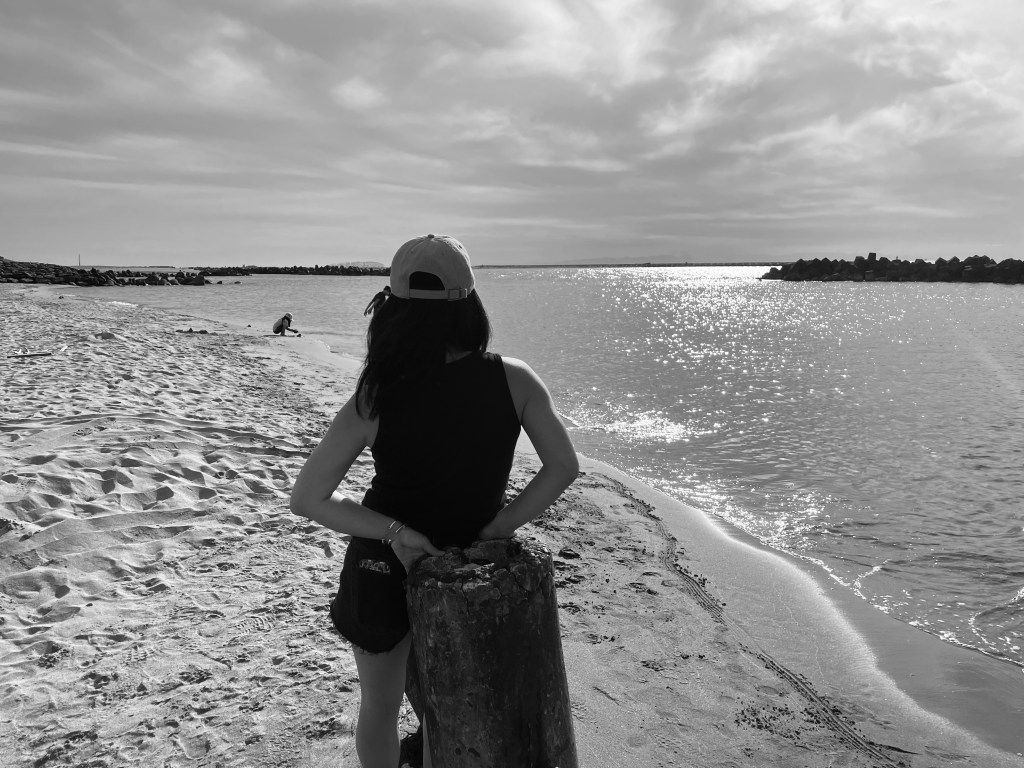
She stood at a distance, imagining her daughter there, playing. She saw how her daughter lit up with glee when she was near the sea, or scampering along the shoreline, collecting shells, poking holes in the mud with a stick, or simply ambling along ensconced in the mercury of being. What is the difference between memory and fiction? She watched and listened, as a mother would watch and listen. The sea splashed forth, retreated, splashed forth, retreated, doing its sea-swing. The rhythm was soothing, unmistakable, dependable. This was the sea of her past, her childhood. Her daughter had never been to the sea, had never played in the sea, as she was playing now, a fugue and ghostly footage in her mother’s time-hunted eyes. She went to the rocks and sat down, staring out from behind dark sunglasses. She recalled days and nights on the beach with her girlfriends. They were young once. I was young once. Now, I am older and my unnamed daughter who never had a chance to experience time moves lyrically along the shoreline, glee-infected. What is the difference between memory and fiction? Ephemera becomes us, and we it, whether we like it or not. Some ephemera, geared on a fast-track, takes away what we never had, what we never knew, what could have been, the sweep of gusts invading a sandy beach. The sea, a smooth slate-gray mirror, briefly, then comes the comb-blade teeth of ripples disturbing the smoothness, and in its place, a grammarless script. What is the difference between memory and fiction? She looked out at her daughter, a hundred feet or so measured in years, in loss, in no time at all, her daughter wandering elliptically along the lacy edge of sea, rhythm unbroken. Behind her daughter’s nimble footsteps, she saw flashing traces of color, the remnants of fractured rainbow in harmonic motion, following the cause of light.

 John Biscello