
(A review of Lisa 2, v1.0, by Nicholas Rombes)
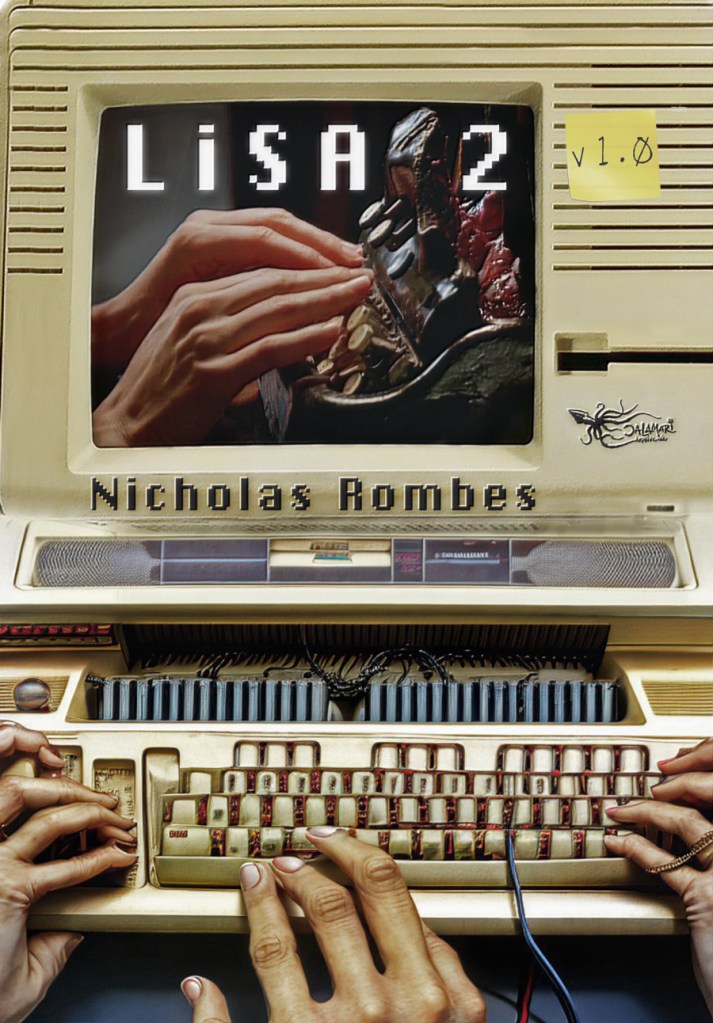
It begins in an irremediable present-tense, a limbo of cirrus and gray, in which the voice of a man, functioning out of narrative necessity, becomes spectral detective to the story of his family’s disintegration. Here, we begin again, the saccharine melody of Percy Faith’s “Theme from a Summer Place” playing, its innocence the honeyed veneer to a malovelently Lynchian underlay, as we cut to a family—husband and wife, David and Lisa, and their eight-year-old daughter, Marin—spending a summer-lovely vacation in rural Northern Michigan. The cottage at which they are staying, belonging to Lisa’s dead aunt, becomes the incubator for an existential nightmare, where his wife Lisa’s boxy doppelganger originates in Lisa 2, an old model Apple computer.
Resuscitating the relic from 1984, Lisa 1 (as David begins to think of his wife), begins writing her plays on Lisa 2, and David becomes aware of changes in her writing: darker, stranger, more overtly graphic. What most disturbs David: There is a different voice he is hearing, both on the page and in the “reality” of their interactions. It is not Lisa’s voice. Not the voice of his wife, the Lisa that he knows and is intimately acquainted with. She is becoming someone else, with physical, verbal and emotional changes underscoring this transformation, or “possession” as David sees it (Lisa 2 is implicated as demoniacal kin to H.A.L. from 2001). David’s interpretation of the situation opens the splintered gateway to a multi-layered novel which traffics in the mutable lore of memory and perceptual slants. How each one of us curates and caretakes our own reality based on fears, projections, predilections, desires. This is reinforced by the novel’s second narrative, in which we get Lisa’s point-of-view regarding what happened that summer and her husband’s disapperance.
Stories emerge from the cracks and fissures, out of internal necessity, and in the case of David and Lisa, the story-behind-the-story (or perhaps parallel to or couched within) is that of a married couple drifting apart, as if their mutual orbit had subtly deviated from the planet around which their lives had been built and regulated. And their precocious daughter is caught in the middle of this sundering and crisis, which is made all the more heartbreaking when juxtaposed against the endangered moments of family tenderness and bonding that are sprinkled throughout. This includes the connection that David and Lisa have forged through films, a sort of second-hand love-language raised from shadow-play.
Remixed hints of Bradbury, Black Mirror and Kafka subtly register, and the novel, in tone and essence, plays out new wavishly lo-fi, creating its own glitchy nostalgia in a liminal haunt. Unease low-humming in blank spaces, ghost-feed in the gaps, is what Rombes specializes in. What is not there creates a visceral and auditory spell, as this book demands to be heard as well as read. There is a line spoken by Fred Madison, the character played by Bill Pullman in David Lynch’s Lost Highway, a creed that could be applied to the unstable calculus of Lisa 2, v1.0: “I like to remember things my own way … not necessarily the way they happened.”
Memory, as flash-cards sequentially patterned to illustrate evidence, is not to be trusted, but memory as a breeding ground for fiction, is wildly fertile in its proliferations. In this respect, Rombes’s novel offers a deliciously twisted and amorphous voyage into hazardous waters, and on the phantom map detailing the dimensions of Lisa 2, the markings might read: Here there be mirrors, screening as monsters.
Lisa 2, v1.0, published by Calamari Archive, available here.

 John Biscello