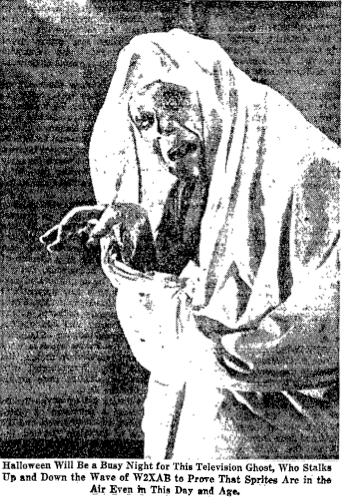
The Television Ghost, considered one of TV’s first dramatic series (1931-1933), belongs to the spectral repository of lost media. Since television technology was in its infancy, the transmission projected a single static image—that of the “Ghost” draped in a white sheet, face painted white, mouth tubercular black. Interestingly, the show’s premise revolved around the ghosts of murder victims recalling how they met their untimely demise (and viewers left to deduce who the killers were), while the show itself became the victim to Time’s merciless erasure (with no surviving footage), and also the medium to its own séance, attempting to conjure evidence which testifies to its vanished life and place in the world of floating images.
Originally from Brooklyn, NY, writer, poet, performer, and playwright, John Biscello, has lived in the high-desert grunge-wonderland of Taos, New Mexico since 2001.
He is the author of four novels, Broken Land, a Brooklyn Tale, Raking the Dust, Nocturne Variations, and No Man’s Brooklyn; a collection of stories, Freeze Tag, two poetry collections, Arclight and Moonglow on Mercy Street; and a fable, The Jackdaw and the Doll, illustrated by Izumi Yokoyama. He also adapted classic fables, which were paired with the vintage illustrations of artist, Paul Bransom, for the collection: Once Upon a Time, Classic Fables Reimagined. His produced, full-length plays include: LOBSTERS ON ICE, ADAGIO FOR STRAYS, THE BEST MEDICINE, ZEITGEIST, U.S.A., and WEREWOLVES DON’T WALTZ.


 John Biscello