Miko

Miko was a singer with her voice in the clouds. They called Miko blue. Occasionally there would be flashes of red. In the fall, Miko would softly mimic the elegy of leaves and become yellow. She would, in voice and longing, die a yellow death and find herself settled among the tender mortuary of leaves. Lost leaves. Lost hours. Lost time. It’s what kept her searching. Not for a specific period in her life, not for a denoted passage. Not for a time she had known. It was the search for a time she hadn’t known. She wanted to find again the time she hadn’t known. The key word in that desire was again. It was saudade as ineffable reflux, as yellow panting for motley leaves and vagrant winds. I don’t know it, this unknown time, yet there is an inexplicable germinal quality to again in my finding it, an inalienable sense of return. Most returns are impossible, or revolve centrifugally around diminishment. Miko’s ghost, having advanced beyond her life at a young age, echoed back to her in song, the invisible passages she must travel in tracking the lost hours.

Posted in Poetry, Prose | Tagged , , , , , , , , , | Leave a comment

The Passion of Joan of Arc

“To know the face of Renee Maria Falconetti, a living mask of plasticity molded to the inner world of a young Joan, is to know the private history of a spiritual crisis. Falconetti wrings every last nuance and syllable out of her facial vocabulary, in taking the viewer through the serrated moodscape of an endangered martyr. There is the glazed vacancy, that faraway within, implying Joan’s intimate consort with angels or the otherworldly. The blinkless moonshot eyes, teetering on the brink of grave absolution. Lids drawn over those eyes, like a sluggish cortege or fated blinds. Falconetti’s amorphic palette of expressions operates with a stringent economy that both speaks and mutes volumes. In one scene, when one of Joan’s Inquisitors demands to know who taught her the Our Father prayer, Joan, with a tear carving a glisten down her cheek, answers—My mother.
Falconetti’s face, in that moment, is an open invitation to enter the mortal suffering of a young girl who dearly misses her mother, her home, her simple life.”

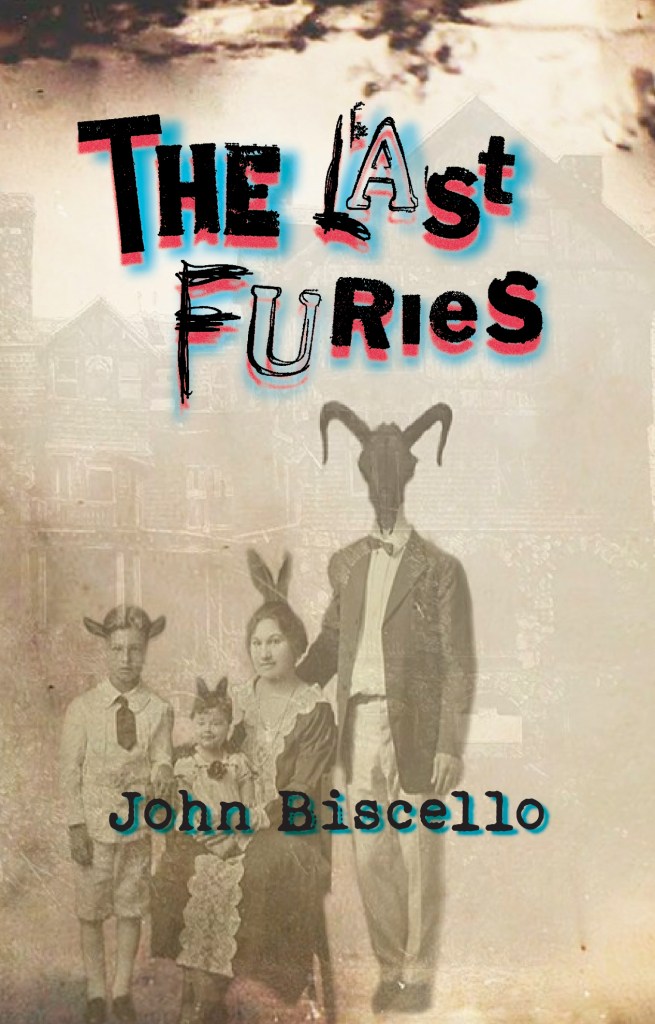
Excerpt from my novel, The Last Furies.

Carl Theodore Dreyer’s 1928 silent film masterpiece, The Passion of Joan of Arc, is one of the key elements in the Furies intersecting narrative.

Print, digital and audio editions of The Last Furies now available through Lost Telegram Press.

Posted in Artwork, Audio, Books, Cinema, photography, Poetry, Press, Prose, Publications, Theater, Uncategorized, Video | Tagged , , , , , , , , , , , , , , , , , | Leave a comment

Bert and George

“All Bert and George ever did was wander in the desert. An endless wandering, sandblasted peregrinations to nowhere, a tubercular odyssey with no point. They wandered, kept each other company, drove each other nuts, got into and out of scrapes and follies. The desert, in all its starkness and death-resin, might not seem like an ideal breeding ground for vaudeville, but these two men showed otherwise. They showed that comedy’s scoliotic backbone originated in a sturdier more epic spine.”

Excerpt from my novel, The Last Furies.

Bert Williams and George Walker – c. 1903

The two men in the photo, Bert Williams and George Walker were a pioneering vaudeville duo (Williams-and-Walker), who were the first Black recording artists in 1901 and the first Black performers to write, produce, and star in a full-length Broadway musical in 1902. About Bert Williams, W.C. Fields said: “He was the funniest man I ever met, and the saddest man I ever knew.”

Two characters, “Bert” and “George,” inspired by Williams and Walker, are forlorn wanderers in the endless desert, which cuts across the mutable geography and timelines of The Last Furies, and the duo’s exploits are recorded as part of a surreal radio program whose bandwidth covers eternity.

Print, digital and audio editions of The Last Furies now available through Lost Telegram Press.

Posted in Artwork, Audio, Books, Cinema, photography, Poetry, Press, Prose, Publications, Theater, Uncategorized, Video | Tagged , , , , , , , , , , , , , , , , , , | Leave a comment

Seance

It was a time in her life when she was not there, not inside herself or her life. And she was pregnant. Pregnant by the wrong man, so many wrong turns and wrong men, and this one, a mislaid night gathering force and momentum in the base of her spine, her small history measled with shivers and white spiders. Placing her hands in the soil and planting things helped, because then the earth became her body, the earth which never suffered an identity crisis. Hands moving through soil was balm and shelter. Another was reading. Entering the lives of others was like playing safely in the country of shadows. The novel she had read, written by a South Korean woman, mirrored her psychic landscape to a tee. In the novel, a woman was breaking apart. Quietly, quietly. No one heard a sound. Until the woman began demonstrating unusual and erratic behavior, a deviation from the norm, and then the woman, as an aberration, was somewhat heard and somewhat noticed. The woman’s ghost took center stage in her life, and she, practicing séance and exorcism all at once, became the body and template to a chronic haunting. A haunting whose night spilled forth into broad daylight. It was, according to many, disturbingly unnatural to see night insinuate itself into day. The woman’s husband was revolted by this grotesquerie. And, by proxy, revolted  by his wife, who had become the insistent bringer of night. The author lights the novel dimly, a muted sepia with hints of ash, and perfumes its air with dying roses. It is a novel that is both quiet and quietly devastating, a cortege of soft footfalls echoing in a long hallway. It was as if the woman in the novel was continually awakening from a dream, and with each inebriated awakening, with each round of stupor and revelation, a new fold emerged, a new edge spanning chrysalis. The novel broke off where the woman was beginning and ending.

By reading this novel, three times, the woman outside the novel took a census on melancholy and came up empty. Yet she kept on reaching, beyond herself. Where was I became where am I, which eventually morphed into I must return … and everything was set in motion. She would give birth to a daughter who would be raised fatherless (which wasn’t novel, many were raised fatherless, whether a father was in the picture or not), she would move back into herself, bloodying her hands along the way in smashing mirrors (but how beautiful the pools of blood darkening the slick lunar glaze)—she had been reflected back to herself as a woman trapped in a novel that no one was reading, and no one had written, but she was not that woman, that woman was trapped in a changeless fate, crystallized in fable and dirge … she was not that woman, she was herself outside a novel, herself inside life building itself to house her name, her slow and holy name committing ceremony to mother-tongues.   

Posted in Poetry, Prose | Tagged , , , , , , , , , , , , , , , | Leave a comment

Moonstruck

A lamp clicks on. A swath of gauzy light projects cinematically onto a chrome operating table, where an umbrella and a sewing machine are making love. Are about to make love. Have already made love. Their romance transcends tenses and conjugations. It is industrial burlesque in a vintage Parisian postcard bearing a blurry postmark from Siberia. The umbrella has a luscious kissprint branding its nylon. A cherry guppy O of a kissprint. The sewing machine is beaded in migrant sweat, its glisten both rummy and supernatural. Between vying artifices, the umbrella and sewing machine consummate. Labor’s love becomes their rhythmic repetitions, their morbid and inlaid fantasy of mesh on metal. Of mesh on metal on metal (let’s not forget the operating table). This illicit union calls for a song. You, who happen to be in the room, slide vinyl from its dusty sleeve and onto the turntable. You lower the needle. A phlegmatic hiccup, a fuzzy stutter becomes the abbreviated prologue to the song that begins playing. An onion-voiced chanteuse, half-bird, half-fox, sings a sugar-rimmed love song bubbling over in molten French. The umbrella, procuring titillation, teases off a swath of nylon, revealing a spindly limb of aluminum skeleton. The sewing machine responds in needlepoint pronunciations, the lusty mosaic of morse code. The moon is somewhere. It doesn’t matter where. It is somewhere—fat, hydrated, honeycombed. The umbrella and sewing machine, equally eyeless, operate through the vagaries of night-Braille. By the time their love affair is immortalized in the postcard you are now holding in your hand (not the same you who was in the room dropping vinyl onto a turntable), you will see two still objects placed in ceremonial proximity to one another, their amoral indiscretions underscored through scorch and lunacy.

Posted in Artwork, Cinema, photography, Poetry, Prose | Tagged , , , , , , , , , | Leave a comment

Moratorium

I.

Beckett spoke about it: the inability to keep quiet. The incapacity to not say stories, not write stories, not place oneself inside stories in which you make and unmake and remake yourself endlessly, an orgy of particles constellating jittery shifts. Beckett, with death’s head irony and gallows brogue, talked often and plenty about silences. He attempted, through literary and theatrical practices, to reach silence, to braid and outline silence. He amassed spools of verbiage in his attempt to penetrate silence, to not say anything, to negate through words taking leave of themselves before settling as shadows. I will say a lot in not saying anything, or, I will say nothing in many words saying nothing. It was a calculated gambit rigged to fail.

II.

Everyone dreams according to their own schedule of being, their own silences and motives, their own sphinxes and disciples. Whether or not you want them to, the stories go on, they go on and on, a vast and inescapable network. Inside me they never stop. The narrative splinters into multiple narratives which splinter into further narratives, a hyper-exponential proliferation of narratives swaddled in recursion. In in, in there, I see myself and lose myself and find myself and wonder about wonder while wondering about myself: solipsism to the nth degree. There is no such thing as a writer who isn’t self-absorbed. Absorption-in-self is their stock and trade, their jurisdiction and wild frontier.

III.

We try and give voice to our silences because so much of us lives there unspoken. We barter fretfully with the unspoken.

IV.

Beckett attempted to reach the end of language through language. He found that dead ends were turnstiles, that vultures were morning doves in top hats. Beckett’s long sonata of the dead was the revival and impossible task he set for himself. He attempts to go beyond words by using words, like trying to starve oneself by gorging on excess amounts of food. You could say Beckett was a literary bulimic.

V.

Beckett tried to corral silence by making silence the domain of language. To not say anything, to ultimately embrace silence, would have meant an even more impossible task—setting down the pen, laying to rest the voice—and placing a moratorium on words. The only way Beckett imagined that could happen would have been through death. Death, flexing dominion, would have to pry the pen from Beckett’s cold stiff hand. Death would have to impose the silence and gag order that Beckett could not attain by choice. From out of smoldering and sepulchral silences words arise, only to immediately plunge back into the abyss. Gravity’s mouth, magnetic and godlike, is essentially a devourer of seasons. And words, trained through voice and causal urges, are always resisting gravity’s vortex just long enough to spell out hints, needs, cries for help and homesickness disguised as small dark birds. We come out of silence only to return there. Lots of words and stories and jig-dancing at night’s edge in between.

VI.

I have no desire to sing tonight.

This is the only line Samuel Beckett managed to write for a libretto which he abandoned.

Posted in Artwork, Books, Cinema, photography, Poetry, Press, Prose, Theater | Tagged , , , , , , , , , , , , , , , , | Leave a comment

The Dance

Her hips began the snakedance, the spasmodic erotic wiggle. She told me to listen closely, and her hips began hissing a slow cadence, the world losing its air, the world a depleted lunar asthmatic in need of oxygen blasts. My breath, as counterpoint, sped up and tried to mimic the accelerated tocking of her hips, their telltale sketches. I am bewitched and find myself lost in that story I once read about a young boy who pit-stops at a cottage in the woods during a long journey, and he is greeted at the door by a wide-hipped woman wearing a kerchief on her head, urging—Come in, come in. The smell plus sound bubbling soup drew him into the warm cozy quarters, and after a good deep inhale, he turned and saw a tit in his face, a puttied slab of matronly breast with a greenish tint. Feed, the woman insisted, feed on this, and with a powerful grip she forced the boy’s head forward and his mouth suctioned the ice-cold nipple, which set off a red flag reminder—a witch’s frozen tit. It has been in other stories, that legend of the witch’s frozen tit, and it wasn’t long before the dark baroque vines growing out of the nipple mummified the boy, and into the soup he went, another in a long line of hungry nipple-suckers.

in the tick-tock rapture of hipcasting

the dirty little seeds

of this haunted story

came into my brain.

these hips were motherblades

and neuron-scramblers

giving me the business.

listen to the low and slow hissing

she insisted

now it wasn’t the world

in my ears losing air

it was me

and i fell into a dark swoon

her hips turned into kinetic empire

over my prostrate ruins

her hips which seemed a million miles away

right in my face.

Posted in Poetry, Prose | Tagged , , , , , , , , , , | Leave a comment

Feathers

As she moved her bladed hips beneath him, small dark starshaped birds tore out of her hips, nipping at the air, and were then immediately sucked back into her hips, as if by an invisible vacuum.

He stopped, and asked—What was that?

What was what?

I don’t know. Something … something shifted. Something in the air.

In the air? You sound like a spooked out kid in a horror movie.

She smiled when saying this. He did too, slightly embarrassed.

Are you enjoying what we’re doing, he checked.

Yes, she lied.

Good, he said, and reinserted himself, just as she vacated her body and searched the room for stray feathers.

Posted in Poetry, Prose | Tagged , , , , , , , , , | Leave a comment

Hips Don’t Lie

The hips don’t lie. They are the truth-telling giants, and the whistle-blowers transmitting through pirate radio. They are also the catacombs and weather satellites of one’s cumulative genealogy. When an old person falls and breaks their hip, it is not just their hip that needs mending, it is also a calcified psychic geography in need of healing. Accumulated history only needs one break, one fracture, a small opening, to find its own level in real-time. The torrent comes—the filed rejections, your daughter’s grief when she lost her first child, your husband’s infidelity, your glasses being swiped at and stomped on when the fight broke out (their three against your one), the colors of your grief and repentance and serial ineptitude running and running and running. Hips, when projected boldly into sex, or dance, carry out eulogy and fiesta all at once, a woozy New Orleans funeral march parceling out grief and joy in a single continuous movement, and you can’t help but feel lighter, a small bird announcing its delicate wings to the drizzles of flight.  

Posted in Poetry, Prose | Tagged , , , , , , , , , | Leave a comment

Hips

I can no longer remember where I was when it happened, only that it happened, it must have happened. Sometimes we cry silent recordings in our bones, or guts, or maybe it is our hips that are the primary storehouses for extracts and tanking. Our bodies harden with history, we become wax figures to our own sclerotic effigies: the hips know. The hips don’t lie. They are, as the doctor suggested—our filing cabinet drawers. Old people who fall and break their hips open the floodgates to regret and despair, to the molasses of grief. It is not just the busted hip that needs mending, it is an entire psychic geography as outlined by the hip, a pivotal ambassador. The breaking of a hip places us squarely where we are with ourselves. The pain that comes is the pain of your daughter’s first heartbreak and how she mourned into the softness of your spongy core, your fortress. The pain is the mother who once forgot you at the gas station during a road trip, you timeless in the bathroom, and she, swept along by a bullying line of time—jostling, impatient—speeding her up no matter what the context or rate of motion, and it is your hips that held the gremlins of being forgotten, your hips as judge and jury to your mother’s thoughtless negligence—your hips declared her guilty, on that and other counts, but no one ever heard your hips issue that declaration, you never heard the verdict charged by your hips … if only your hips had large lips, if only your hips belonged to a choir … yet all remained unspoken, a cold case quivering in a strongbox slotted in a furnace.    

Posted in Poetry, Prose | Tagged , , , , , , , , , , | Leave a comment