The grayvoice,
wrinkly in its
soiled pucker
and ancientnewness,
heeded,
and sung,
to freight
and hoist
the downgoing
adventure
up, up, up
into silvercoined
spates of eventide,
the furthest reaches
so damned close
to dreamcountry
it hurts to fathom
or leave behind.
My heart,
forever the weeded ace
and wandering fool,
scored to secret pines,
sings of resident gloam
pooled
in that forest
of backlit signs,
which grows beyond
its clipped horizons
to invigorate departures,
spurred by the genius
of wordless roots.
Posted in Poetry, Uncategorized
|
Tagged dream, expression, forest, John Biscello, love, pines, poem, roots, soul, spirit
|
(Excerpt from Broken Land, a Brooklyn Tale)
I am standing over myself: a runt-skinny kid lying flat on his stomach, right elbow hunched, the stubby pencil in his left hand ferociously scribbling on a piece of unlined white paper. The paper is set directly against pimply stone, so the kid’s handwriting comes out jaggedy and warbled, as if his left hand were stutteringly drunk.
It is August, early afternoon, and the heat is a thick fuzzy animal big enough to smother all of Brooklyn. A voice snaps from the top step of the stoop—Done. You wanna hear?
The voice belongs to Jimmy, age eleven, and he is wagging several white pages in his hand.
Of course I want to hear, I think, and nine-year-old-me sets down his pencil and shifts to an attentive seated position, angling his head toward Jimmy, who is poised on the top step of the stoop.
It’s called The Double Curse of Cross and Bones, Jimmy says, then smacks his lips together loudly several times before launching into the story, which begins: Two wasn’t always Miller’s unlucky number.
I am not only standing over but am also inside of nine-year-old-me, which means I can feel the zip and crackle that comes with being an audience to Jimmy’s stories. There is something in Jimmy’s voice, a buttery charge, and the way the words skate off his tongue in happy bunches and intimate clusters, which makes me yearn for my own special relationship with language. That is why I am out here, on Jimmy’s stoop, scribbling stories, part of our everyday summertime ritual, same as stoopball, firefly-hunting and playing war in the park.
When Jimmy is done reading he quickly begins talking about something else, before I have a chance to comment on his story. This too is part of the ritual. I can feel how awkward I am inside of myself, as if my body were a too-tight suit that causes me to fidget and squirm. That being said, Jimmy’s story has somewhat taken me out of myself in a way that my own stories do not, and I hear myself say—You’re a great writer Jimmy—to which Jimmy snappishly responds—Aw shaddap with that Salvo … ready for some stoopball—and he produces a pink Spalding and bounces it on the stoopstep, rubber pecking stone.
To say that the scene dissolved would be inaccurate. The scene between Jimmy and nine-year-old-me continued to play out, but I, as a witness, had gone. I was now back in my apartment in Bay Ridge, late morning, December, staring vacantly at the open notebook laid out on my desk.
My mind suddenly shifted to the realization that this was my third session with my ghost, Y., and unless I purchased another block, my last. I had planned to space out my sessions over an extended period of time, yet after the first session, and all that it had unlocked, I couldn’t help but use the other two right away.
I didn’t know what ghosting felt like for others, nor the ways in which it changed them, but for me it felt like a high-impact acid trip. I could spend what felt like hours looking inside of and behind a single word, and specific words had become things of felt beauty. Wisteria, octave, innuendo, scallion, solvent, calliope, adagio. Then there was Scandinavia. I had developed an exquisite crush on the word Scandinavia. To write it meant to enter a space of complex nostalgia. Nostalgia for what was and what was not, nostalgia for the future, nostalgia for your own death, nostalgia for the people you were and the people you were not. Scandinavia, more than any other of the charmed words, had become a lighted peephole through which I spied other lighted peepholes. I was on the inside looking out at the inside looking out.
(Excerpt from Broken Land, a Brooklyn Tale)
I climbed the stairs to the third floor, where Jimmy’s apartment was. When I got to his door, I knocked, not expecting an answer, and not getting one. I turned the knob, expecting the door to be open, and it was. Two for two. A good start.
Jimmy, I called out.
Silence.
Jimmy’s apartment smelled thickly of cigarette smoke and something else—something missing. My nose couldn’t put a finger on what that smell, or un-smell was.
The apartment was in total darkness. Recalling the layout of Jimmy’s place, I crossed from the foyer into the living room. I fumbled for and found a light switch on a lamp and clicked it on. The lamp was no ordinary lamp. It was Betty Boop. Her arms were elevated at 45° angles, holding the lampshade over her rotund head, which was now cast in silky bronze light. The light also set off the red dress she was wearing, giving it a luminous, old-Hollywood look. Betty’s saucer-shaped eyes seemed to be looking directly into me. Maybe they were trying to tell me something.
I’ll question you later, Miss Boop, I said, knowing that I wouldn’t.
I surveyed the living room. No tell-tale signs of disturbance or disorder. I saw a phone on its cradle, set at angle on an end table. I picked it up. There was a dialtone.
While checking the other rooms, I found a second phone in the kitchen, and it too was working. Above the kitchen counter, near the fridge, I spotted a laminated photo of Gabriella, Jimmy’s mother, taped to a panel. The photo had been given out as a memento at Gabriella’s funeral. I stared at the photo and never before realized how much Gabriella resembled a catcher’s mitt. Mostly in the cheeks and mouth.
To the left of the photo, rosary beads hung on a nail. I removed the beads and stuffed them in my pocket. I’m not overly superstitious, but you never know when rosary beads might come in handy.
I sat on Jimmy’s recliner in the living room and waited. Instinct told me that Jimmy wouldn’t suddenly turn up, but it felt good to be in an apartment that wasn’t my own. I went to the fridge to fix something to eat. Not much there. In the freezer I found Pepperoni-and-Cheese Hot Pockets. I microwaved one on high for two minutes, then poured myself a glass of grape soda and went back to the recliner.
While eating, I looked at Betty Boop looking at me. The space between us lengthened, as did time. I went through Jimmy’s records, which were stocked in crates on the living room floor. I wanted to hear something that would kick me in the ass and send me to the zoo. I settled on Led Zeppelin III. I tried playing the record at a modest volume, but that wasn’t doing the trick so I turned it up full-blast. Now there were fuzzy reverberations. Now there were tingles.
I nuked another Hot Pocket and poured myself another glass of grape soda. This time I added ice. I was in no rush to leave. Music sounded better in other people’s homes. Food tasted better. Drinks drank better.
It was in the middle of “Immigrant Song” when a woman appeared in the doorway of the living room.
What are you doing here, she shouted over the music.
I could ask you the same question, I shouted back.
So I did.
What are you doing here?
We looked at each other, unsure as to who should answer first. Playing the gentleman, I decided it should be me.
I went to the stereo and turned off the music. Then I said—I’m a friend of Jimmy’s. I came to check on him.
The woman, who remained a statue in the doorway, regarded me suspiciously.
I wiped my Hot-Pocket-stained fingers on my pants, then stepped forward slowly, so as not to alarm her, and extended my hand. I’m Salvatore Massimo Lunezzi. But you can call me Sal.
The woman looked at my hand, as if it were toxic, then looked into my eyes and saw me as no better than my hand. I let my hand fall limply to my side.
The woman remained still and silent and performed invasive surgery on me with her eyes. I didn’t know where to turn, as it felt like she was stripping off my skin, bit by bit. After a long torturous minute of this, I was thoroughly ashamed of the fact that I existed.
I tried to crack wise—See anything you might find useful—but my voice betrayed me. It had come from a thirteen-year-old boy blindsided by puberty.
Suddenly, the woman’s features softened and her icy demeanor melted.
I’m Anna, she said, in such a friendly voice it made me go jelly inside. She smiled extra-big, then extended her tapered ivory fingers for me to shake. I clumsily groped her fingers and shook. Her hand was soft and clean-feeling.
For those of you who might be wondering: Anna was not a scissor-legged blonde. She had dark hair. Real dark. Like a night-forest with no moon. The color of her hair violently contrasted her skin, which was white. Real white. Like bleached bones. Or virgin snow. There was something very classical, very noble, about Anna’s facial structure. Especially her nose, which reigned as the stately matriarch over the rest of her features.
Anna breezed by me and sat in the recliner. I couldn’t take my eyes off her dress. It was an aquatic green with scalloped white trim. It puffed and flared and possessed the character of a decadent pastry. Ornate, pretentious, crème-filled.
Hungry, she said, and gave me a smiling look.
My face and hands grew hot and itchy. Had she seen into the depravity of my pastry association?
Then, with a quick sideways glance, she indicated the plate on which I had eaten the Hot Pocket, and said—What’d you have?
Hot Pocket, I said, relieved by what she didn’t know.
Anna fished out a nail file from some secret pocket in her dress and began filing her glassy nails. This put me at ease and I sat down on the couch, facing her.
Mind if I sharpen a pencil?
Anna gestured—Be my guest.
I took out a pencil and my pencil sharpener and went to work. Shavings collected in the seashell ashtray set on the coffee table in front of me.
Keeping her eyes focused on her manicure, Anna said—I had to look you over in that way. Just to make sure.
I recalled her eyes and what they’d done and felt a renewed wave of shame.
What were you making sure of, I asked.
That you really were Jimmy’s friend.
Me and Jimmy grew up on the same block in Bensonhurst, I volunteered. Where you from?
Not Bensonhurst, Anna said, still not looking at me.
I kept at her. You Jimmy’s ladyfriend?
Anna laughed like I had hit her with a funny stick.
By ladyfriend, what do you mean, she said.
I don’t know, I said.
I’m not Jimmy’s I-don’t-know. Nor am I his main squeeze, as the phrasing goes. Like you, I’m Jimmy’s friend.
Anna blew nail-dust off the tips of her fingers. I stared at those fingers as they extended fully. They were like unfinished sentences implying something poetic.
Sal, Anna started and paused.
That pause, which I believe was intentional, allowed me to reflect on how it was the first time Anna had spoken my name aloud. The effect was dizzying. Like she had given birth to me, signed the birth certificate and baptized me all in one syllable.
(Excerpt from Broken Land, a Brooklyn Tale)
There’s not really a name for what I do. I am not an investigative journalist, I am not a private eye. I am not a minstrel essayist. There are many things that I am not.
If I were forced to impose a designation upon what I do, I’d say I’m a … curious. That’s all. Just curious.
Anyway, if I had an office and it had been a rainy Tuesday, then a tragic blonde with legs like scissors strong enough to cut a flesh-and-blood man in half might have walked in … but that’s not the way this story begins.
This story begins with a phone call from Jimmy Barrone, a writer and old friend of mine, who I hadn’t heard from in years. His voice was tight and choked with tears, as he gurgled—Still curious, Salvo?
I knew it was Jimmy, because he was the only one from the old neighborhood who still called me Salvo.
Jimmy, I said, long time no hear.
Jimmy’s dead, Salvo. Do you understand? I’m dead.
I countered Jimmy’s hysterics with good old-fashioned logic.
You’re not dead, Jimmy, I said. You’re talking to me on the phone, therefore you’re alive. Got it?
Jimmy snuffled some kind of primitive response, and went on—I don’t know who’s who anymore, or what’s what. I’m breaking apart, Salvo. Fractals. Twelve Jimmy’s, then thirty-six, then forty-eight.
I followed the beat of Jimmy’s math, and tried to get through to a singular Jimmy, the one I had known since childhood.
Jimmy, I said, before you go to pieces with all this radical subdivision, tell me exactly what you think is happening.
I’m not me, were the last words Jimmy spoke before the line went dead.
I called back: a busy signal.
I calmly hung up the phone and sat at my desk. I picked up my plastic pencil sharpener and began sharpening pencils (#2’s, orange-yellow). It was what I did when I wanted to think things over, calmly.
While my curiosity had been piqued, and I fully intended to head over to Jimmy’s place and see what I could find out, I was not going to rush into the matter. I was not one to rush into anything, even when a distress signal has been fired like a flare in my direction. I didn’t trust distress-signals, especially when they came from writers. Especially writers who had been raised Catholic and had grown up in Brooklyn.
I also understood that anxiety and panic were highly contagious maladies. It was my responsibility to keep myself clean and healthy and sound. Which required exacting detachment. Too little and you were caught in a trap. Too much and you drifted away.
My cat, Keaton, an ash-gray beauty with lantern-yellow eyes, leaped onto my lap. He stared up at me, as if he wanted something.
What, I said.
He responded by switching his lean tail, side to side, like a pendulum.
My nails dug into Keaton’s scalp and gave it a good scratch. Keaton purred, like a pigeon making love to a toy motorboat, and closed his eyes.
I sharpened pencil after pencil, while playing Jimmy’s words over and over again in my head. I tried out various configurations. I rearranged the original sequence, broke them down into independent syllables, played the sentences backwards, as if trying to uncover a satanic message.
After my fourteenth pencil, and with none of the configurations amounting to a breakthrough, I rose to my feet. Keaton fell to the floor, gracefully. He gave me a cutting look, then padded away. I went into the bathroom, flossed, brushed my teeth, and gargled mouthwash. Then I flossed again.
I put on my shoes and hat and overcoat. I grabbed my pencil sharpener, and six unsharpened pencils, and stored them in my coat-pocket. Then I left for Jimmy’s.
Outside, the night had teeth and it was raining. It suddenly dawned on me: it was Tuesday.
Maybe if I had an office, I reasoned to myself, a scissor-legged blonde would walk into it. You never know about these things.
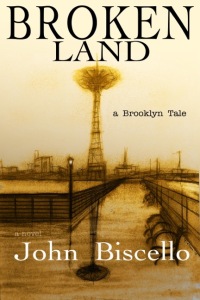
The new edition of my first novel, Broken Land, a Brooklyn Tale, is now available for preorder (Unsolicited Press), in anticipation of its official relaunch.
ABOUT: A spectral, existential noir set against the aging irons of Coney Island and old guard lions of hip hop and silent film, Broken Land, a Brooklyn Tale tracks the singular odyssey of would-be sleuth and soon-to-be wordsmith, Salvatore Massimo Lunezzi. Prompted by an enigmatic phone call from a writer-friend claiming to be dead, Lunezzi launches an investigation that leads him to Ghostwriters, Inc., a company selling inspiration to struggling writers through the medium of “ghosting.” From Buster Keaton to Arthur Rimbaud, a boozy and brilliant dwarf to an enchanting femme fatale, Lunezzi is drawn deeper and deeper into the soul of story where fiction and reality inevitably converge.
To dig nails
into the ciphered history
of her skin,
unmapped,
to take a pirate’s tack
in plundering
the source
of her sap
and scent,
flagged
on the bare teeth
of wolves wind.
To abide,
faithfully,
the recording angel
on my shoulder,
to dream, trebled,
with eyes
and ears open,
glass pressed
against the thin, plasmic
veil separating one world
from the next,
a straddler
and eavesdropper,
since Childhood,
on behalf of a life
that does not advertise
or wear itself out
so easily,
requiring a tease,
like the snake
charmed from its straw basket
through music’s make,
or the tongue
flirting with air
to gauge the climate,
tastefirst,
to placehold
the arabesques
and delicate savor
of an endlessly
moveable feast,
we,
legends
to our own
called stars,
are born
with stories encrypted
in our hearts,
each telling
a listening,
and recollection,
echoes recorded live
on a loop,
just one long
blues song
forever at the mercy
of Eternity’s remix.
Ask the divine
wordless forecast,
ask the motherless child
staring off into the distance
as she sails a paper airplane
out the opened window.
I have spent
so many years
detailing
and outlining
and mapping out fractures,
a pirate osteopath
with a cartographer’s bent,
and now, galvanizing
a mutiny meant to take me
out into uncharted waters,
I see, beyond my terror
of the deep,
how beautiful
and necessary it is
to sire oneself,
to become king to your own sovereign majesty,
queen to your own indigenous wilds,
child to your own supple wonderscape,
how the Soul,
captaining its own plight
and gambit,
forces you to confront
the countless break-ups,
freeze-outs,
and unrequited love affairs
you’ve had with your self,
multitudes untethered
and adrift in gloam,
but now, your Soul says,
is an opportunity for nuptials
of ancient-newness, a crystallization
that will show you how the future
was never anything more
than a latent ember
awaiting the divinest spark.
Posted in Poetry, Uncategorized
|
Tagged beginner, child, dream, heart, John Biscello, king, poem, queen, soul, wonder
|


