“So let this be the aim of the meditation: to turn one’s innermost being into a vast, empty plain, with none of the treacherous undergrowth to impede the view. So that something of ‘God’ can enter you, and something of ‘Love’ too. Not the kind of love-de-luxe that you revel in deliciously for half an hour, taking pride in how sublime you feel, but the love you can apply to small, everyday things.” – Etty Hillesum
“… even in the darkest times we have a right to expect some illumination . . . This may well come less from theories and concepts than from the uncertain, flickering, and often weak light that some men and women, in their lives and works, will kindle under most all circumstances and shed over the time that was given them on earth.” – Hannah Arendt
“I felt right at home in this mythical realm made up not with individuals so much as archetypes, vividly drawn archetypes of humanity, metaphysical in shape, each rugged soul filled with natural knowing and inner wisdom. Each demanding a degree of respect. I could believe in the full spectrum of it and sing about it. It was so real, so more true to life than life itself. It was life magnified.” – Bob Dylan
“In waking life, when all is well and cares fall away, when the intellect is silenced and we slip into reverie, do we not surrender blissfully to the eternal flux, float ecstatically on the still current of life? We have all experienced moments of utter forgetfulness when we knew ourselves as plant, animal, creature of the deep or denizen of the air. Some of us have even known moments when we were as the gods of old. Most everyone has known one moment in his life when he felt so good, so thoroughly attuned, that he has been on the point of exclaiming: ‘Ah, now is the time to die!’ What is it that lurks here in the very heart of euphoria? The thought that it will not, cannot last? The sense of an ultimate? Perhaps. But I think there is another, deeper aspect to it. I think that in such moments we are trying to tell ourselves what we have long known but ever refuse to accept—that living and dying are one, that all is one, and that it makes no difference whether we live a day or a thousand years.” — Henry Miller
“Everything is begging to be discovered, not accidentally, but intuitively. Seeking intuitively, one’s destination is never in a beyond of time or space but always here and now. If we are always arriving and departing, it is also true that we are eternally anchored.” — Henry Miller
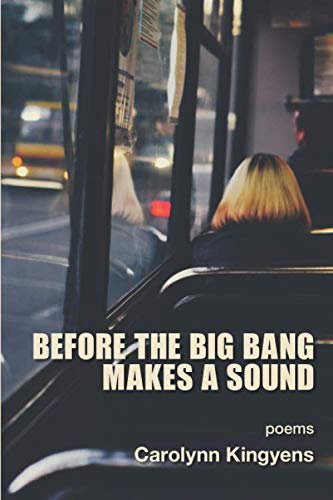
Listen closely. You will hear the rhythmical jazz of a leaky faucet. The creaking floorboards in the attic of memory. The sound of a heart crunching beneath the weight of a life, and then again, that heart’s resilient rising announced in a brassy timbre. And then, with hearing attuned to the sensitive antenna of imagination, you will hear the sounds of a self slowly yet insistently emerging from its cocoon. The pangs, joys, agonies, promises and griefs that are housed within metamorphosis, form the quivering core of Carolynn Kingyen’s debut poetry collection: Before The Big Bang Makes A Sound (Kelsay Books).
Kingyen’s tenderly engaging collection pulses with directness and intimacy: these are poems that call for warm lamplight as their confessional beacon, or for the shadowed creases in unmade bedsheets on a Sunday morning. As a restless soul, sifting through wreckage and claims, through psychic bric-a-brac and unsullied miracles, Kingyen has pieced together, with deftness and candor, her own heart-shaped box of offerings. Or an altar, where the broken and the fulfilled keep each other company. Reflections on being a mother, a wife, a writer, a daughter, a seeker, a lover, and a woman all her own, both harmonize and contradict, merge and dissolve, as Kingyens renders the multiple slants and angles that challenge our perceptions of who we are, who we aren’t, who we hoped to be, who we are in the process of becoming. Shedding, and reckoning, are very much at play in these poems, which demonstrate the strength of vulnerability that speaks to our humanness. Lines from Beck’s melancholic gem, “Strange Invitation,” were conjured during my trip through Kingyen’s world: “I remember the way that you smiled/When the gravity shackles were wild/Something is vacant when I think it’s all beginning.”
The feels, flavors and tones of New York create the urban panorama in which many of Kingyen’s poems take up residence, jaywalk across busy streets, ride crowded buses, sneak into bodega basements, or, in moments of lucid illumination, glimpse disco-ball cloud-smoke eternity on West 85th and West End Avenue. Then there’s the merciless vice-grip of Time, when geared to the city-grind:
“In New York, the city that
never sleeps, Time is boss.
She owns us, but we still
rush to beat the clock;
rush to beat rush hour—
strangers in a sea
of strangers bum-rushing
subway doors like cattle.
Time laughs.” (The Parable of Time)
Or, in a blues-tinged case of nostalgia, it is “Coney Island” whose air is peppered with wistfulness:
“I want to go back in time
where hope hangs heavier
than the moon;
when love is as hard as a fist
inside the throat;
a time when real butterflies
replace the redundancy
of roller coasters.”
Here, then, in this wonderful debut collection, is the paper-thin grace of butterfly wings brushing against the glass of memory and longing, with an aureate tint backlighted by gratitude.
“What an abyss of uncertainty, whenever the mind feels overtaken by itself, when it, the seeker, is at the same time the dark region through which it must go seeking.” – Marcel Proust
“This transformation is what all artists seek: to become like mythic heroes—Prometheus, Achilles, Odysseus, Aclestis, Athena—so that we mortals can see our fates reflected in their journeys as we do in the journeys described in ancient myths.” – Erica Jong

 John Biscello