My sad tenderness, what comes over you all at once?
When I have reached the most awesome and the coldest summit
my heart closes like a nocturnal flower.
—Pablo Neruda, “I Have Gone Marking”
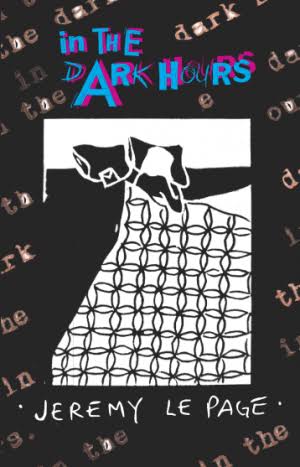
It is easy to imagine this breed of shy nocturnal flower, this intrepid night-bird, as cardiac kin to the poems populating Jeremy LePage’s debut—In the Dark Hours. This unassuming collection, which is equal parts lucid and hazy, bears a pacific disquiet that gently palpitates. None of these poems arrive with a bluster, nor do they hit you over the head—these are verses that murmur and eavesdrop, subtly nudge, or skitter in and out of focus like small furtive animals. Fragile grace is the spiritual backbone of this collection, which registers with a touch of weightlessness (imagine a light dusting of winter snow on a bare branch), and evanescence, regulated by micro-doses of gravity. LePage drops visual clues such as footprints in the snow leading nowhere, or bread crumbs in a maze, which testify to the roundabout journeys we are always taking, rooted in a futility underscored by hope. It is with sober, precise, and clear-eyed simplicity that LePage plays tour guide on the narrow path to the interior (paradoxically harboring expansiveness):
“My life carries on
in a non-specific way.
A shadow of an evergreen
is my guidepost.
I am not a teacher or a holy man,
but I have an influence that is subtle.”
(“Shadow of an Evergreen”)
Or, the muted nostalgia of a bygone self:
“At night I want to hear the trains
how I used to hear them;
the windows rattling and my body
searching for a bit of rest.
I just want to hear their sound, again,
as my youth fled from me on one of those trains.”
(“The Trains”)
I couldn’t help but recall Japanese poets of old, such as Issa and Ryokan, as well as their Western literary disciple, Gary Snyder, when encountering the elliptical, airtight, nature-infused quality of LePage’s chamber poems. Two other threads running through the collection: one is what feels like a secret love-letter in transit, or blurry scraps from a burning memory log; the other revolves around the hazards and guilty pleasures of daydreaming, of time spent with one eye obsessively glued to the lens of a projector situated in the cinema of the mind.
Erin LePage’s minimalist lino-cuts, resonantly stark and eye-catching against the wash of white page, are interspersed throughout the book and serve as an ideal glyphic underscoring to the tone of the collection (Erin also created the cover artwork).
I would be remiss if I didn’t mention the publisher of In the Dark Hours, Lost Telegram Press, an up-and-coming micro-press based out of Ontario (founded by Christopher Shoust), which is quietly and diligently carving out its niche and impressing its stamp on contemporary indie literature. This is due in good part to Shoust’s visually dynamic and conceptually engaging designs—hand-made, hand-printed—a craftsman’s old-school savvy and vision carried out with meticulous care, and the convicted belief in books as works-of-art and not just products to be churned out with homogenized disposability. In this respect, the pairing between Shoust’s little-engine-that-could press, and LePage’s elegiac verses, is a fluidly harmonious one.
(In the Dark Hours is available in print and digital editions at: losttelegrampress.ca)