
-
Archives
- September 2026
- August 2026
- May 2026
- April 2026
- March 2026
- February 2026
- January 2026
- December 2025
- November 2025
- October 2025
- September 2025
- August 2025
- July 2025
- June 2025
- May 2025
- April 2025
- March 2025
- February 2025
- January 2025
- November 2024
- October 2024
- September 2024
- August 2024
- July 2024
- June 2024
- May 2024
- April 2024
- February 2024
- January 2024
- December 2023
- November 2023
- October 2023
- September 2023
- August 2023
- May 2023
- March 2023
- February 2023
- January 2023
- December 2022
- November 2022
- October 2022
- September 2022
- August 2022
- July 2022
- June 2022
- May 2022
- April 2022
- March 2022
- January 2022
- December 2021
- November 2021
- October 2021
- September 2021
- August 2021
- July 2021
- June 2021
- May 2021
- April 2021
- March 2021
- February 2021
- January 2021
- December 2020
- November 2020
- October 2020
- September 2020
- August 2020
- July 2020
- June 2020
- May 2020
- April 2020
- March 2020
- February 2020
- January 2020
- December 2019
- November 2019
- October 2019
- September 2019
- August 2019
- July 2019
- June 2019
- May 2019
- April 2019
- March 2019
- February 2019
- January 2019
- December 2018
- November 2018
- October 2018
- September 2018
- August 2018
- July 2018
- June 2018
- May 2018
- April 2018
- March 2018
- February 2018
- January 2018
- December 2017
- November 2017
- October 2017
- September 2017
- August 2017
- July 2017
- June 2017
- May 2017
- April 2017
- March 2017
- February 2017
- January 2017
- December 2016
- November 2016
- October 2016
- September 2016
- August 2016
- July 2016
- June 2016
- May 2016
- April 2016
- March 2016
-
Meta
Self-Love Supreme
The time will come
and say, sit here. Eat.
all your life, whom you ignored
the photographs, the desperate notes,
Posted in Poetry, Uncategorized
Tagged derek walcott, heartsong, love after love, poem, Poetry, self-love, truth, valentine
2 Comments
Bag o’ Rags Resurrected
On the next-to-last day of our campaign, we are proud to present an exclusive musical introduction to Adam Swanson playing the 1912 tune, “Bag o’ Rags” (composed by W.C. McKanlass), which was the theme song of the Keystone Kops.
Troy masterfully crafted and wove together footage from our private session with Adam at his alma mater, Fort Lewis College, and Adam’s gig at the Diamond Belle Saloon, in creating this unqiue cinematic memento. View the video here.

Posted in Audio, Cinema, photography, Press, Prose, Publications, Uncategorized, Video
Tagged adam swanson, Bag o Rags, ballad of the cuckoos, Cinema, durango, indie film, John Biscello, Keystone Kops, ragtime piano, sheet music, troy paff, vintage
Leave a comment
The Dance
Our actors, Clint Murphy and Rita O’ Connell, received choice tutelage from choreographer, dancer and director of the Academy of Performing Arts, Miss Amber Vasquez. If you are someone who is interested in and engaged by process, and watching moving parts synthesize, Troy beautifully captured Clint and Rita’s private dance session with Amber. This recorded practice, which relates to our film’s black-and-white slow-dance sequence, flowers and unfolds with a natural narrative arc, culminating in an exquisite final shot.
Watch the dance here.

Way Out West
We are thrilled to announce that Adam Swanson, one of the world’s foremost vintage performers of American popular music, including ragtime and early jazz, will be contributing his musical talents to our film, Ballad of the Cuckoos. Adam, who is the only four-time World Champion Old-Time Piano Player, has showcased his formidable repertoire at Carnegie Hall, The Kennedy Center, and has accompanied silent films at the prestigious Cinecon Classic Film Festival at the Egyptian Theatre in Hollywood.
This past weekend we undertook a field trip to Durango, CO, and recorded a private afternoon “concert” with Adam, in which he played us a slew of tunes on a Steinway grand, including the Laurel and Hardy theme song, “Dance of the Cuckoos.” Then, at night, we got to watch Adam unleash a siege of old-timey exuberance at his “home-away-from home,” the Strater Hotel’s Diamond Belle Saloon, where Adam is the resident pianist (following in the musical footprints of Adam’s hero, mentor and friend, the late Johnny Maddox, a ragtime legend, who was the Saloon’s pianist from 1996-2012). We will be releasing video clips of Adam’s performance later this week, but here are some photos that capture the spirit and joi-de-vivre of our time-capsuled night at the Saloon .


To find out more about our film, visit: igg.me/at/cuckoocinema
Cuckoos in Toyland
When you’ve grown up, my dears,
And are as old as I,
You’ll often ponder on the years
That roll so swiftly by, my dears,
That roll so swiftly by.
And all the many lands
You will have journeyed through
You’ll oft recall,
the best of all,
The land your childhodo knew
Your childhood knew.
Toyland, toyland,
Little girl and boy land,
While you dwell within it,
You are ever happy then.
Childhood, joyland,
Mystic merry toyland,
Once you pass its borders,
You can ne’er return again.
These lyrics, written by Victor Herbert for the song, “Toyland” (which was featured in the 1934 film, Babes in Toyland, a.k.a., March of the Wooden Soldiers, starring Laurel and Hardy) poignantly exemplifies the spirit of the “toyland” we are striving to create for our Cuckoos. And we need YOUR help in architecting this playscape.
Toys and games from different eras, spanning the 1950s-1990s, are being sought to help us create the stylized and distinct character of our children’s room. Below is a list of some of the specific toys and items we are looking for, but we’re also on the lookout for “unspecified” vintage toys and games that might strike our fancy. What we’re asking for in this cinematic scavenger hunt: take a photo of your toy and send it to us. We will then sift through prospects and make selections. If your toy is selected to appear in our film, we request that you mail it to us (as a donation). You will receive a special thank you in the film credits, and for those who take a fun, playful, dramatic or “cuckoo” picture with their toy, we may include your pic in the gallery roll-call of “toyland” pics during the film credits.
We want our Cuckoo Room to become a repository of collective childhood dreams and memories, a shared place of warmth, play and sanctuary.
You can email pics to: johnbiscello@gmail.com. If we use your toy, we will send you the address to which it should be posted.
Some of what we’re seeking:


Also, there are thirteen days left before our campaign ends, so please visit our page if you want to find out more about our indie film and become part of our growing Cuckoo flock: igg.me/at/cuckoocinema
We are winging our way forward, one shimmying feather at a time. Here’s to the land of childhood and all its inspired magic-making!
Posted in Books, Cinema, photography, Press, Prose, Uncategorized, Video
Tagged ballad of the cuckoos, childhood's land, film, island of misfit toys, John Biscello, laurel and hardy, scavenger hunt, toyland, toys
Leave a comment
Love Is
I miss you already,
the sun-kissed daisy
whispered to the migrant
flake of snow,
which clung
like a hopeful bead
to the daisy’s
delicate petal
before dying a lover’s death
and melting.
Posted in Poetry, Uncategorized
Tagged flowerbeds, it's a love thing, John Biscello, Poetry, seasons, snowflake's fancy, spring kisses winter
Leave a comment
This Side of Burlesque
And then came the day
when he realized he was free,
always had been
to enjoy the abstracted
stage-play of his thoughts
and their formations,
something of an idiot’s delight,
same as the scabbed-glass opera
of the world without,
its tragedies and follies
swaddled in petticoats
of burlesque
(the people burning—
Take it off, take it off)
how interesting it all was,
how thoroughly enjoyable
it was to be alive,
a mortal gob of wax engaged
to the briefest of candle-flickers
in the ceremonial scheme of dark and light,
how much he would miss himself—
who he was, who he was not—
when he was gone,
when his persona had melted
into a puddle of anonymous molecules
that had to be on their merry, migrating way
(goodbye vagabond molecules!)
while his very last thoughts
might plants the seeds
for a brand-new play
starring god knows who
in some crumbling, time-clipped tenement
of Eternity
where, AT PRESENT,
was an immutable law
and not just a parenthetical
stage direction.
The Jackdaw and The Doll
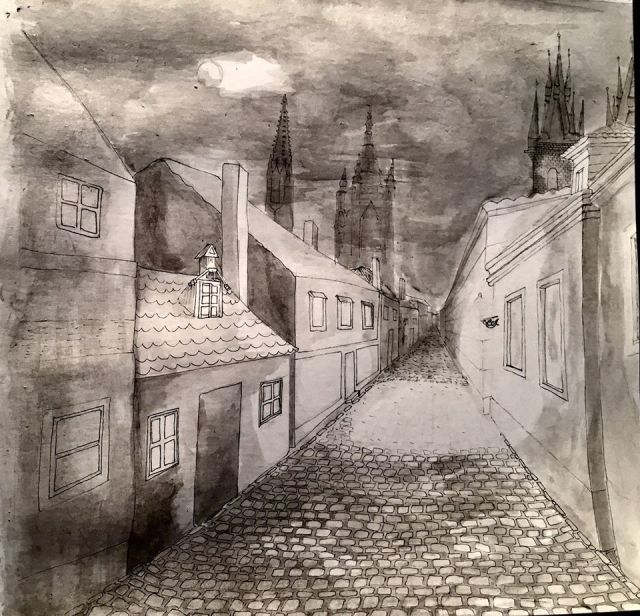
A work in progress street scene from “The Jackdaw and the Doll,” a fable I wrote inspired by a story about Franz Kafka. The book is being illustrated by Izumi Yokoyama, as her artistry interprets and realizes a world of fog, mystique, shadows, storytelling, dreams and true love.
THE JACKDAW AND THE DOLL: K. leads a double life. Timid office clerk by day, storyteller by night. But not just any storyteller. Transforming into a jackdaw, K. takes secret night-flights around the city, collecting moments of inspiration. Confronted by sickness, and “The Shroud” which has haunted him since childhood, K., joined by his new love, Dora, moves away from home to The City of Birds. It is there that he will meet a young girl, heartbroken over her lost doll, and be given a golden chance to share the healing magic of storytelling.
A fable about love, compassion and creativity, inspired by a story about the writer, Franz Kafka.
Posted in Artwork, Prose, Uncategorized
Tagged children's book, fable, franz kafka, izumi yokoyama, John Biscello, mood piece, prague, Prose, storytelling
Leave a comment
Welcome to the Dollhouse
Ballad of the Cuckoos is offering an intimate sneak-peek into “the room” in which our protagonists find themselves trapped. This small-scale model of the “Cuckoos Nest,” was created by my daughter, Sierra-Lindsey Biscello, who has been buiding custom-made dollhouses from recycled materials for the past several years. We hired her to build a miniature facsimile of our room/set, in which she meticulously crafted its assorted contents and structure. “The Cuckoos Nest” is featured in a moody cinematic short, filmed by Troy Paff, and set to the music of Anthony Distefano. Take a tender and cryptic trip into the haunted dollhouse, with your tour guide and architect, Sierra.
To find out more about the dollhouse (which we plan to offer as a one-of-a-kind perk), about Sierra’s dollhouses, and about our film, and how you can support us, go to: igg.me/at/cuckoocinema.
Fool’s Play
To marvel dumbly,
and trespass,
with a sense of the infinite
backlighting a wink–
this, the way of the Fool,
or sacred is as sacred does,
when trusting the air
in its holy relationship to plunge.

Posted in Poetry, Uncategorized
Tagged fool, in air we trust, John Biscello, poem, sacred clowning, taking the leap, the plunge, the reign of naivete
Leave a comment

