
-
Archives
- September 2026
- August 2026
- May 2026
- April 2026
- March 2026
- February 2026
- January 2026
- December 2025
- November 2025
- October 2025
- September 2025
- August 2025
- July 2025
- June 2025
- May 2025
- April 2025
- March 2025
- February 2025
- January 2025
- November 2024
- October 2024
- September 2024
- August 2024
- July 2024
- June 2024
- May 2024
- April 2024
- February 2024
- January 2024
- December 2023
- November 2023
- October 2023
- September 2023
- August 2023
- May 2023
- March 2023
- February 2023
- January 2023
- December 2022
- November 2022
- October 2022
- September 2022
- August 2022
- July 2022
- June 2022
- May 2022
- April 2022
- March 2022
- January 2022
- December 2021
- November 2021
- October 2021
- September 2021
- August 2021
- July 2021
- June 2021
- May 2021
- April 2021
- March 2021
- February 2021
- January 2021
- December 2020
- November 2020
- October 2020
- September 2020
- August 2020
- July 2020
- June 2020
- May 2020
- April 2020
- March 2020
- February 2020
- January 2020
- December 2019
- November 2019
- October 2019
- September 2019
- August 2019
- July 2019
- June 2019
- May 2019
- April 2019
- March 2019
- February 2019
- January 2019
- December 2018
- November 2018
- October 2018
- September 2018
- August 2018
- July 2018
- June 2018
- May 2018
- April 2018
- March 2018
- February 2018
- January 2018
- December 2017
- November 2017
- October 2017
- September 2017
- August 2017
- July 2017
- June 2017
- May 2017
- April 2017
- March 2017
- February 2017
- January 2017
- December 2016
- November 2016
- October 2016
- September 2016
- August 2016
- July 2016
- June 2016
- May 2016
- April 2016
- March 2016
-
Meta
Between Stations
I was on the subway platform waiting for the train when I spotted a thin girl in torn jeans and bright green tank-top walking in my direction. Her hair was a bushel of unruliness. As the girl drew nearer I realized it was Anya and called out her name.
Her response was slow, as if my voice had reached her on delay.
Daniel, she said, my name clotted in gauze.
Then recognition brightened and lifted her voice and turned my name into a coarse cheer—Daniel. Holy fucking shit. Daniel.
Anya breezed into my arms for a hug. I could feel too much of her skeleton.
Anya mumbled words into my ear. Her voice was as whittled as the rest of her.
I was looking over her shoulder and wanted to keep looking there. I was afraid to release her and step back because then I’d have to look at her face. I knew it bore waste and ruin that my mind would latch onto. And play back to me again and again. The portrait of a death-mask that now covered Anya’s real face, her buried one.
Inevitably I stepped back and took in what was not there, what had gone missing.
I didn’t need to follow the track-marks on Anya’s arms to understand the nature of her cave-in.
We talked while we waited for the train. I don’t remember if our exchange was awkward, hurried, sentimental, remote, can’t remember anything we said to each other. My memory of it is white noise.
Then I did something which made me feel shitty and ashamed but I did it anyway.
When the train pulled in I told Anya I wasn’t getting on, that I had just gotten off the train when I saw her and was headed out of the station.
Something in me couldn’t bear the prospect of sitting next to Anya on the train, of us talking. I didn’t want there to be any words between us. Ours had become a ghost story and I wanted silence to fulfill its arc.
I’m not sure if Anya knew I was lying, but I suspect that she did because if I had gotten off the train I would’ve been on the opposite platform and Anya, no matter what state she was in, was never easy to fool or put things over on. Her radar for bullshit was top-notch.
Plus when saying goodbye she hugged me with such emphatic force that I was sure she was trying to emotionally implicate me for abandoning her. At least that’s how my guilt registered it at the time.
My final image of Anya is through the train window, her back turned to me.

Posted in Books, Prose, Publications, Uncategorized
Tagged Brooklyn, first love, girl interrupted, John Biscello, no man's brooklyn, Prose, subway encounter, train station
Leave a comment
Anya and the Dark
Remember when we were kids and we’d sometimes have sleepovers and listen to the dark together? That’s what you called it, Anya, listening to the dark.
Sometimes we’d pretend to be camping. We’d set up a tent and eat candy and look up at the glow-in-the-dark stars on my ceiling, and the planets and meteors too. The stars were yellow and the meteors were red and the planets were all different colors. And you’d say let’s be quiet and listen to the dark and we’d listen for a little while but you could never keep quiet for long and you’d start asking me questions like what did the dark sound like to me and what was I thinking but my favorite part were those intervals of silence when we were not only listening to the dark but also breathing it and perhaps dreaming it. At least that’s how it felt to me.
And it was because of you Anya that I started naming different types of dark, listing them. Warm-dark, cave-dark, void-dark, womb-dark, sleep-dark, Eros-dark, blank-dark, siege-dark. And then there’s that anonymous dark that gets inside your head and behind your eyes and coils around your lungs and constricts your breathing. There is also curse-dark, which casts a prolonged spell, a pall. And then there’s lonely, but naming it doesn’t help. Not in the same way.
Now that you’re gone Anya and I’m still talking to you I wonder what kind of dark this is. Communion-dark, veil-dark?
We used to listen to the dark together as kids and now I talk to the dark with the hopes of hearing from you again. Echo-dark. Or better yet, Anya-dark. An entire category of dark devoted exclusively to you. How do you feel about that?

Photo by Anthony Distefano
Posted in photography, Prose, Publications, Uncategorized
Tagged alley, anthony distefano, first love, John Biscello, New York, no man's brooklyn, shadowlands, street photography, the dark
Leave a comment
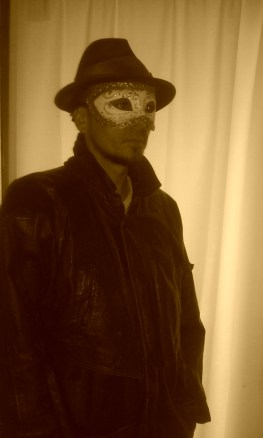
Demasking is a Crime
Signs everywhere: rectangular slabs of mildly glowing metal that warned in red lettering: Demasking is a crime.
It was in the year _______ that a maskless society had ceased to exist. A decision was made by people who made decisions of that nature (yes, the masks, the decision-making, the proper authorities, all of this stuff was no longer part of delineated hierarchies—who did what and why—all had become a cryptic jumble wadded in bowels of electric red tape, society had become a covert subset of gumballs.)
If you took your mask off, your facial pores would release an acidic chemical issued from micro-pellets which had been implanted into your face (the implants were government regulated), and your face would burn. And keep burning. It would be excruciating, intolerable, and it wouldn’t be long before you put the mask back on, which would defuse the acid.
Everyone was issued a mask. All the masks were the same. A uniform anonymity, a sea of samefulness, or rather there was only one standard issue mask with six different colors. Red, green, blue, purple, gray, yellow. The colors you were assigned to wear was based on zoning. Your location dictated your color. When a child was born they had to be registered with the M.O.D. (Masking Ordinance Department) and the implants would be surgically implanted into the facial pores. If child wasn’t registered, and the proper authorities found out, the child would be seized and enrolled in what was known as the Nursery. No one knew the location of the Nursery, or much of what happened there, but basically: the Nursery children were wards of the government until they were old enough to be released back into society.
There were the fugitives. Those who refused the indoctrination of masking. Fugitives, unfortunately, didn’t have a very long shelf-life on the outside. The barefaced ones stuck out like sore thumbs and were easy to apprehend. Some did wear masks, of their own stylistic design and color. These masks might be modeled after indigenous masks from Africa, from the Lakota-Sioux, from Zuni, they might be modeled after Venetian or No masks, there was masks of colorful anarchy, masks with long Zucchini-hose noses, masks engraved with floral patterns and imprints, masks of sleepy revolt, attic masks, eyeless mouthless masks with swirling riots of cursive, masks abstracted into vowels, masks of warbling translucence, masks that radiated a funereal whiteness, masks of glaring hyperbole and exposed hypotheses, masks that had frozen the contorted muscles of screams into the mask’s texture, masks with quizzical half-smiles petrified into question marks.
There was an entire subculture of people who crafted and donned masks to assert their individualism, or to place a visual and symbolic wedge between themselves and the Anonymites (how they euphemistically referred to the uniformly masked members of society) and they flung themselves and their radical masks into the thick of it all, like bombs in a crowded marketplace, bombs with the kamikaze intent of exploding umbilicial strands of mucus and magma. Their time out in society usually didn’t last very long. Anonymites would turn against them, turn them in. Bad apples exhibited in a public cart was something that most people didn’t want to see, or to be made visually available to the world at large.
White vans would roll up and men dressed in white linen and white caps, looking very much like crosses between milkmen and painters, would seize the Radicals and wrangle them into the van and they would not be seen or heard from again. Rumors had it that they went to a place called the Repository, though, like the Nursery, not much save for the notion that it probably existed, was known about it. The men in the white linen outfits and white caps were referred to as the Dogcatchers. No one knew who first started calling them that, but it stuck and circulated, and as a result the Radicals then became known as Strays.
Dogcatchers, Strays, Anonymites. The world had become quartered into agitated simplicities.
Posted in Prose, Uncategorized
Tagged cover up schemes, demasking is a crime, dystopic stew, hidden agendas, John Biscello, Prose, watchwords
Leave a comment
These Glacial Times
I have been in a coma now for sixty-seven days. No one reaches me anymore. And I don’t reach them. Everything that has to do with reaching—in, out—all of that is done. It is jazz that has lost its voice.
I am adrift on a blue glacier in the middle of the sea.
Here, there is no history, only invention, and hopes for survival.
Here, from my icy alien distance, I pitch a network exec on my idea for an interactive pop odyssey through American culture and void, I get all crackly and charged telling them how it will be the remix of a remix of a remix ( I get lost in layered Matroyshkan notions such as these, by which we feel there is more, always more, when I know there is always less, so much less…)
Yet being adrift on a blue glacier
in the middle of the sea
in a coma for the past sixty-seven days,
I am inclined to fill up all this
hobbying nothingness with my own set of illusions,
which of course are not mine at all but remixes
of remixes … you get the idea.
Here’s where the odyssey begins.
It is a book, it is a film. It is interactive. You are part of the action. You must participate—physically, sensually, imaginatively, etc.—in order for the venture to be successful, in order for the gaps to be filled in. You also have the choice to leave the gaps completely unfilled, empty. You don’t have to do anything. This book will exist without you, same as you’ll exist without this book. There is no mutual bond of dependency. There is the Mission Impossible creed, remixed: (now being spoken through the ghost of Tom Cruise through an aging grade school’s P.A. system, also aging: If you choose to accept this mission…)
You are aboard a space ship. There are lots of blinking lights, a multi-colored siege of blinking lights and cool-looking consoles that are both futuristic and retro, Star Trek as a stillborn space-baby. All of it is very thrilling, very exciting, you are intrigued and highly stimulated by all the things around you that are beyond your grasp, which is pretty much everything: the lights, the humming consoles, the ironing board on long spindly insect legs, the blue-skinned alien with a coiled pyramid of dark, glossy hair set atop her head, the way she is ironing a yellow shirt that looks like it might be Lycro, and the way the steam exhales from the iron like the hissy snortings of a gentle baby bull.
You are aboard the ship, you don’t know why. A dignified-looking gentleman, with dark eyes and spongy gray hair that stands several inches high off his scalp, turns to face the screen, that is to say the camera, and speaks directly into it (this he does after after all the people and activity around and behind him have gone into a freeze). The Captain engages, in a rulerthick stentorian—We, the characters? You, the readers, the audience?
We have stopped. When we start again, you will see a black screen.
Posted in Prose, Uncategorized
Tagged american pie, boy interrupted, dreamlife, John Biscello, jukebox, pop odyssey, Prose
Leave a comment
Ow, She Said. And Wow.
She stared
at the solitary gull
perched on a craggy rock.
The sea, like undulating slates
of purplish steel,
or bruised rust,
while a glaring wound
of a sunset poured scarlet ribbons
from its Martian gash.
The gull flies away, a dilating comma
with unknown plans.
Sometimes
it was nearly impossible to bear,
all this beauty and sadness,
the feathery crux of registered crushes,
excruciate in their due course
of perishing, and remembrance.
Posted in Poetry, Uncategorized
Tagged down by the sea, John Biscello, life's many crushes, love and lore, poem, Poetry, sun and sea and flight
Leave a comment
D’Arc Night of the Soul
(For All Hallow’s eve, a “witch’s” tale)
Enlightened, perhaps. God-engorged hormones, maybe. Regardless of why, Joan, you were the rebel prototype
long before James Dean zipped up a red jacket,
or Marlon Brando mumbled and curled his upper lip into a totem,
before Louise Brooks and Josephine Baker and Mae West scorched bits of screen and earth and tore hearts to shreds with a flickering edge.
You, Joan, were the world’s most famous, cross-dressing heretic,
the It-girl of alleged sorcery,
a rebel very much aligned with a cause,
coursing a waxwork future and belated sainthood.
It was in your father’s garden, age thirteen, when you first heard the voices, saw the visions.
St. Michael, St. Katherine, and St. Margaret, a trinity of Beauty unbearable that brought tears to your eyes.
But they didn’t come to serve as spiritual eye-candy, or to bring you otherworldly comfort. They were delegates, delivering a message direct from the Man Upstairs, a command which, to any less a mystic, might have fallen on deaf ears, a task that would have registered as preposterous or impossible, but not for you Joan: faith was your stock-in-trade.
So you listened, took it in, an illiterate, thirteen-year-old peasant girl on the cusp of puberty, being told that it was her duty and obligation to help lead France to victory over the English, to fulfill a destiny that had been part of France’s prophetic pipeline for generations: a virgin will come, a miracle-worker, and she will restore France to its former glory.
You would have been happy to stay at home spinning wool with your mother, tending to the animals, gazing dreamily upon the milk-bearded faces of clouds, to pass your time as a humble girl quietly in love with God, but you knew it would be bad form, downright impious, to argue against a trinity of saints that had taken the time to visit you, just you, in your father’s garden.
Not to mention, when God gets in your head, like a luminous migraine, or a marvelous tumor, what can you do except abide?
The rest is history. Or myth. Legend. Pages from a tattered scripture in a gilded dustbin.
Something.
There were the victories over England, the coronation of Charles VII, at which you wielded your iconic banner, your capture and imprisonment.
If there had been tabloids, you, Joan, would have been splashed daily across the headlines:
France’s Favorite Maid to Be Tried for Heresy
Joan, the Teenage Witch, Refuses to Admit Allegiance to the Devil
Of course, as God’s cheeky, chosen daughter, you had no intention of going gently into that good night.
Several times you tried to bust out of the big house, often falling from great heights.
When the Inquisitors grilled and viciously quizzed you with the hopes of railroading you into an incriminating confession, you shrewdly sidestepped and evaded all their tactics, case in point:
Inquisitor: Are you in God’s grace?
Joan: If I am not, may God put me there, and if I am may God so keep me.
You had the bastards squirming, Joan, eating their own blasphemous piles of shit.
But, as it went, they rode a gross miscarriage of justice all the way to the stake, to that fateful day,
May 30th, 1431, when they burned you, not once, not twice, but three times, before scattering your ashes into the Seine.
You were nineteen.
Twenty-four years away from being acquitted at your retrial,
four-hundred and seventy-eight years away from beatification,
and four-hundred and eighty-nine years away
from official sainthood.
Which just goes to show that history may be written by the winners,
but the rewrites belong to a much higher and more mysterious order.


Images by Guy Denning
Posted in Artwork, Cinema, Poetry, Prose, Uncategorized
Tagged arclight, Guy Denning, halloween, joan of arc, John Biscello, poem, realm of the spirit, sorceresses and saints, the passion
Leave a comment
Night at the Opera
At first there was darkness, and there had always been darkness.
Then the stars turned on.
And music played, as if silky notes drifting through a night-cloth dome of windows,
and in this way wonder entered the scene.
Wonder mated with music and seeded people.
People would go on to forget their original parents, but would long to return
to this mysterious unknown, this insoluble home.
There would be that tenderly agonized longing, that homesickness,
and there would also be the deepdown knowing
that emptiness knew the score, i.e., that they, the people,
are made up of so much more of what they are are not
than of what they are, or think themselves to be.
The whole thing was an opera, a fretted fiasco,
with the recording of a mute fat soprano
playing in the background.
Posted in Poetry, Uncategorized
Tagged John Biscello, opera, poetry that does magic, space riot, the darkest seeds, the fat lady singeth
Leave a comment
From the Sorcerer’s Handbook
Do not explain music
Do not explain dreams
the elusive penetrates everything
You must know that everything rhymes
—Wols
There is something deeply comforting about this, deeply reassuring. Everything rhymes. A universe of correspondences, of sequential richness, metaphysical jazz. It really is a world of poetry. Tuning in to the rhymes and melodies, and giving praise and honoring and playing. You’ve got to be playing. Participation is the key to mystery. To feeling into the mystery, allowing it to hum and hymn inside your bones, to gather inside you in tiny concentric whirlpools.
Everything rhymes. A never-ending stream. Now I know why the writers tried to catch waves in the stream-of-consciousness, why they chased after the shadows of darting minnows.
Sure there might be bigtime ego involved, but one thing doesn’t negate another, its ego plus the fact that there is a trust and belief in the ultimate rhythms and jazz and cosmic waves rolling ceaselessly.
The ocean. The bottomless qualities of the ocean. What if we ever made it to the bottom of the ocean, the very “bottom”, and we found that there is no stopping, there is no bottom to the ocean, no bottoming out, it just goes on and on and deeper into the mystery, or we are taken to another world, another dimension. The ocean, like space, may just go on and on.
At the heart of the deepest ocean, there might just be deeper mystery.
A wondrous endlessness to the whole thing.
Everything rhymes. Stacked layers of rhythms, a structural base of sound, vibrations, patterns, recursion.
Everything touches. There is no actual separation. Separation is an illusion, a con-job. The touching is the truth.
Everything rhymes, everything touches.
The creation of a new mythology. Rooted in most ancient, pagan mythologies.
The re-mythologization of art, return to a state of sacred devotion, the world re-sacralized, and we praising, honoring, playing, engaging.
A felt-sense of the world’s magic, or currents running without pause, a divine seething, a convent of pure feeling for the unseen, for the numinous. A re-spelling, through chants and incantations, to language as a vehicle of sorcery, and you create the world which simultaneously creates you.
Everything rhymes.
Nothing to worry about. No explanations needed.
No dry brittle logic or tortured rationale.
Everything rhymes. A letterless alphabet of sorcery. A hidden lexicon of numinous glyphs. To get there, you must not assemble or contrive or apply boxy logic to a sense of ordered architecture.
No, no, no. What you want to do: hallucinate deeply, and abandon yourself to a state of reverie. It is this state of reverie, this state of longing (for the elusive and inscrutable), this is the sovereign way of the sorcerer and the poet.
To get there, you must be in touch with the blue flame.
From the blue flame, within the blue flame, through the blue flame—sorcery!
Everything rhymes in this letterless alphabet of sorcery, in this bottomless soup of jazz.
See
the blue flame
a thin mesmeric
whip of a girl
dancing ever so slightly
inside the milky-opaque
slab of glacier.
See
the blue flame,
grow intimate with her,
and feel your world shift
forever.
Posted in Poetry, Prose, Uncategorized
Tagged alchemy, John Biscello, poesy, rhyme-scheme, sorcery, turning prose to jazz soup, universal musings, why not?
Leave a comment
October’s Bones
In honor of the 50th anniversary of Jack Kerouac’s “death-day” departure for roads unknown.
When I was a young man,
a budding scribe
eager to blossom white fire,
and scabbed lotuses,
you meant the world to me.
You exposed me to velocity bop
and piggyback rhythms,
to applepie windowsill jazz
and summerlight porchswings,
to mesmeric wreaths of pipesmoke
and the windswept skulls
of railroad Octobers
in brown, turning earth.
You souleased
in such a relatable way,
the freight of boyhood
infused your eyes
with saloony verve,
your fingers jitterbugged
across enormous swaths of whiteness
and void,
you bootlegged
lyrics
Melville-style,
just to keep yourself
in the running with
Hemingway’s bulls
and Joyce’s Dublin,
whitewhale hunting
came second nature to you,
some people do impossible
like half-made angels
leveled by mortal booms.
Their very gimpness
embodies
the purest translation
of Heaven’s perishable blooms.
Yours
was the religion
of sweet, sad farewells,
the capered goofs
of littleboys spitballing
I love yous
to girls in pinafore dresses
at Sunday movie matinees,
or profane leerstruckness
at the silver crucifixes
resting
between ripening mounds
of sweatbeaded cleavage,
yours
was the racket of vaudeville,
commingled with a fanatic’s
fairground zeal,
the Zen weatherman
who once proclaimed:
The taste
of rain—
why kneel?
Yet
it wasn’t long
before
Fame,
that highly-sought-after
stalk-legged
dame
in a mink stole
and whitehot spray
of jewels
came along
and cornered you good,
and the Shakespeare of Lowell
quickly became
Little Boy Blue,
nowhere to turn,
as the flesheaters
closed in,
and all you could do
was blow wild, careening
solos through your trusty horn,
and pour
rivers of whiskey
over your soul’s
godgiven.
Recognition didn’t kill you,
alcoholism did,
but let’s just say
recognition
mixed with booze
in the redlight district
and pinkened sensitivity
of wounded souls
sharpens
and humors itself
through the gallows.
When names
balloon too big,
when the print is lettered
through the Hypemachine,
it is easy
to lose sight
of what it is we’re reading,
Fame’s overlay
the distorting veneer
so you are no longer reading
what you see or feel
but rather what you’ve heard
from a hivemind,
secondhand rumors dispel
direct engagement with mystery,
what others know
and say
becomes the order of the day,
and that long day’s journey
into night
is, by definition
and default, history
(its winners wearing blinders
while leading the blind)
but before the siege,
and after the deluge,
Jack Kerouac, Ti Jean, Sal Paradise, John Duluouz,
and all the other names that became you,
there were the words, the holy writ,
the godblasted scrolls of one man’s
selfspeak upon the earth,
that rabid seeking
as gilded sibling
to Dylan Thomas’s hilltop cloudcry—
Oh, as I was young once,
and easy in the mercy of his means,
Time held me green and dying,
Though I sang in my chains like the sea.
You,
Mr. Kerouac,
were one of the wind-twisting
chain-rattlers,
frothing fringed baubles of sea
at the mouth,
as if to prove
you were nature herself
(this the way of angels, the way of children)
and when I look back,
I am immensely grateful
that you took the time
to give the spirit of boyhood,
its vim and keyturned sorcery,
as well as music’s
plasmic alchemy,
its reverential due
in a society
where doped dreams
register
way too much sleep
to ever claim their meek
as soundly vital
and golden.


