Plot

   Yesterday I buried my mother. Two mothers. Maybe three, or four. I have had many mothers in the small hours of this modest and shrinking life. All my mothers are tassels of foam threading mighty surf. All my mothers are exiled and liberated to a single body-host and fugitive core. The passions of men are septic, and in need of drainage. And not just any drainage: mother-drainage. Mothers swallow cesspools and geyser them upward and outward with religious fury. Mother-tongues perform rites on multiple levels. The stars wink, gratefully. Mirages rage fruitfully, and I say this because here I am, burying my mother again, for the first and always time, there is no end to these burials, no cessation to the amount of mothers becoming funeral batter (the heat of the earth causing them to rise, to rise) … In truth, or in reality—choose your semantical poison—I have buried none of my mothers, not a single one, but I have rehearsed these burials in the cradle of story, I have made myself minister and undertaker, reciting the canticle (while imagining dirt engraving its signature under my nails): I buried my mother yesterday. If I were to start again, and here I start again, I might say—Yesterday I buried my mother. And she buried me. It was a mutual agreement, a tacit bond.

   There’s something about burying the mother who buries you that engenders hallucinogenic closeness. My mother and I become vivid and clear, near and dear to each other in our correspondent deaths, in our shared burial plots.

Posted in Poetry, Prose | Tagged , , , , , , , , , , | Leave a comment

Winter

   I say my mother’s grief was white on white … I say this, but this is not true all the time. The colors change. My mother’s grief has been pink, blue, red. Yet, more and more, when I am feeling my way into and through my mother’s grief (my psychic wanderlust almost always takes me through these regions), yellow has been the primary color. In my travels, I have painted my entire body yellow, and stood in a grove of autumn trees, yellow leaves flashing gentlest elegies, and I sync into solidarity (we are not only autumn trees, cortege and metamorphic, we are also the liminal ambassadors of grieving mothers), and when there is nothing left of me, when I have been stripped bare by winter’s prologue, I cut off the dead pieces of myself and fashion them into a cradle, a bare bones cradle into which I slot myself, where I hibernate all the way through winter, the faces and limbs and mouths of winter eclipsed by a long sleep. This I do to honor my mother, who has always despised winter, who was always sad and depressed the entire winter season—Mother, let us sleep until winter is over, let us sleep as shrunken cradle-mates through the dark glacial void of winter, and I will be the first to rise, I the son always the scout and advance guard, I will rise and tell you when winter has gone away, and you can open your eyes, your blinking baby-bird eyes, but please, do not look at me, turn your head, I cannot bear direct gazes, you know this, turn around, let me see the back of your head, my first temple, and I will become your daughter, your new season’s daughter, brushing your thick hair quietly and diligently.

Posted in Poetry, Prose | Tagged , , , , , , , , , , , , | Leave a comment

Vigil

When I watched my mother brush her hair, it made a scraping electric sound: vibrating plastic teeth sinking repeatedly into a fuzzy animal. I loved watching my mother brush her hair. I’d make sure to always stand behind her, so I couldn’t see her face. I always felt safer when I couldn’t see faces. Faced held eyes and eyes were too much. Mix the eyes in with mouths, noses, and everything else that formed a living portrait, and it was too much for my nerves to process. But the backs of heads: I was safe. That is, until the day my mother told me she had eyes in the back of her head. My staring became a different pastime, fraught with anxiety. Why couldn’t I see the eyes that were seeing me? How deep were they hidden in my mother’s forest of hair? Years later, when my mother got sick and had to shave her head, I no longer believed in the eyes, but still I had to check … my mother’s head was my first temple.

Posted in Poetry, Prose | Tagged , , , , , , , , , , , | 2 Comments

Mayday

My mother’s grief attends nightly to her bones. It is a funeral in reverse, or a funeral in slow-motion, longing for a mourning long delayed. We stall ourselves in grief—idling, passive—and the freest parts become small dark birds tearing away from us, ghost-birds in a winged cortege. We arc and circle ourselves in grief … render childlike outlines in faded chalk.

   I have mimicked many voices to track and capture my mother’s theriomorphic grief, therefore my own: history pared and blood-let outside of time. Inside time, once upon a time, my mother was, as she tells it, a terrified-out-of-her-mind seventeen-year-old, not knowing what was going on, loud brassy voices and foot traffic, screaming her head off, nurses trying to calm her down, bound to a gurney, soprano squeaking of rubber wheels, drugs administered … and there, in the Grand Guignol of the delivery room, it came from her, into this world, a defiant trauma and membered shock, an exile and introduction swaddled in its own immediate reality … the baby banged furiously on air, tiny flailing fists producing music from large pools of nothing. I drank these large pools of nothing into my lungs, and I was initiated: I was passed around, I was wiped, I glided through air, I felt the burning of light, I was a pair of eyes just turned on. Everything, not so much new, as it was returning to me again, with a different cast, different narrative, different set of circumstances, and I, memoryless, cased in a spastic wingless body consumed with hunger.

Posted in Poetry, Prose | Tagged , , , , , , , , , | 2 Comments

Knives

   My sister says she doesn’t have many memories from childhood. When she looks back, there’s nothing there: a blank screen. I never asked her if she saw black or white in her absence of memories.

   One of her earliest memories, one that became archival celluloid: my father, drunk and drugged out of his mind, chasing her and my mother down the block with a knife. My sister and mother ducked into a doorway next to the toy store around the block and hid there until the threat had passed.

   I don’t know where I was when this happened. My sister shared this memory so many times that I began living through it, as if I too had been there, and in moving through this memory with the propriety born from intimacy, I may have modified it. The knife, for example: Did my father have a knife when chasing my mother and sister? Or did I plant the knife in my father’s hand, based on another memory, one which belonged to an ex-girlfriend who told me that one of her first memories was of her father holding a knife to her mother’s throat. Did I combine the two fathers into one? Did I duplicate the knife and place it into my father’s hand, making me an accessory in this revised episode of violence?

   I had experienced my father during lunatic flights of rage, and knew very well that not only might he wield a knife during such moments, but he was also capable of slashing or carving into one of us with a blind fury. It was possible. The knife was possible. Mutilation or death … possible.

   When I asked my mother about the memory, she said she had no recollection of that happening. So, in her story: no chase, no knife, no husband. It was a blank screen. Whether she saw black or white in that absence, I don’t know, because I never asked.

Posted in Poetry, Prose | Tagged , , , , , , , , , | Leave a comment

Dinner, No Voices

   I waited. We waited. A storm was coming. It had to be. He had returned from rehab several days earlier, after having been gone for two months. My father had always born pouchy bags under his eyes, but there, in rehab, the pouchy bags had unnerved me. I think because they brought attention to his eyes, and these were different eyes from before. These new eyes seemed to shine with fear, or projected a nakedness that I couldn’t bear. These eyes belonged to a bewildered and overmatched little boy, and I didn’t want to see a boy where my father was supposed to be.

   Now, at the dinner table, it was my father but also it wasn’t—this man was quiet, subdued, and the thing that most disturbed me: the way in which he handled his fork and knife. Before, his knife would tear into meat with murderous ferocity, and his fork would produce all kinds of noises—pinging, clacking, rattling—when meeting his plate and teeth. My father had always eaten with brute vigor. Not this version of my father. This one ate, almost gently, and I never knew my father, or my mother, for that matter, to do anything gently. The common vocabulary of their actions and gestures registered as frenetic, frantic, hasty, insistent … everything in the key of volatile drama. Which was why my nerves couldn’t handle what was happening. When you are expecting death metal and instead receive a soft classical ballad … the echoes of metal keep reverberating within your nerves. The ghosts of the music you are not hearing can be more powerful than the music you are hearing.

   Because my father was silent, my mother was too. As was I. No one had anything to say. We ate in caged silence. We ate as if someone had just died in this apartment and out of respect for their memory we were eating quietly. I snuck glances at my father’s pockmarked face. A boxer’s face, mashed-up in different places. At any moment, I expected the rage to return, the sudden shift to fury … he’d snap at me, or my mother, for some perceived offense we had committed, something he found displeasing about us. It never came. This man was a punchless choirboy, and his knife and fork were used less like murder weapons and more like ordinary utensils.

   I wanted to scream into his face, wake him up to who he was, who he had always been, who I knew him to be. Who we knew him to be. My mother was an accomplice in this caricature of silence. I wanted to scream at her, too—Don’t you know this is false, this peace is a façade and charade? I know it. Why don’t you know it? You will revert back to being savages, the two of you hurling homicidal and suicidal impulses at each other, and I, I will feel right at home again, dying to escape.

Posted in Poetry, Prose | Tagged , , , , , , , , , , | Leave a comment

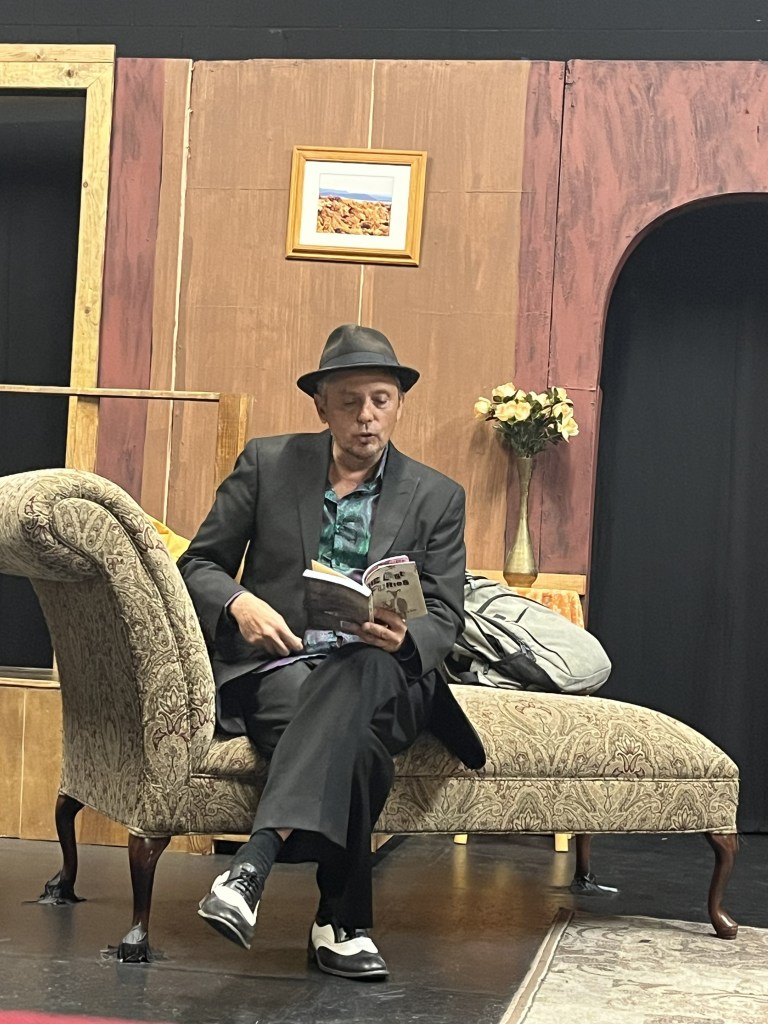
Teatro Paraguas

Thank you to Teatro Paraguas for being such a gracious host, and to the people who attended and supported the reading and book-signing in Santa Fe. It was a sweet, humanly connected, word-warmed evening.

Posted in Artwork, Audio, Books, Cinema, photography, Poetry, Press, Prose, Publications, Theater, Uncategorized, Video | Tagged , , , , , , , , , , | Leave a comment

Mortuary

Miko was a singer with her voice in the clouds. They called Miko blue. Occasionally, there would be flashes of red. In the fall, Miko would softly mimic the elegy of leaves and become yellow. She would, in voice and longing, die a yellow death and find herself settled among the tender mortuary of leaves.

   Lost leaves. Lost hours. Lost time. It’s what kept her searching. Not for a specific period in her life, not for a denoted passage. Not for a time she had known. It was the search for a time she hadn’t known. She wanted to find again the time she hadn’t known. It was saudade as ineffable reflux, as yellow panting for motley leaves and vagrant winds.

   I don’t know it, this unknown time, yet there is an inexplicable germinal quality to again in my finding it, an inalienable sense of return. Most returns are impossible, or revolve centrifugally around diminishment. Miko’s ghost, having advanced beyond her life at a young age, echoed back to her in song the invisible passages she must travel in tracking the lost hours.

Posted in Poetry, Prose | Tagged , , , , , , , , , , | Leave a comment

Operating Theater

   I have become moonless in my grief, a paled comparison. But to what? To who I used to be? What I expected to become? I feel as if I’ve been laid out on an operating table, and Time, as a methodically slow and exacting mercenary of a surgeon, has been dissecting me piece by piece. When the operation is done, when I am standing again on my own two feet, what will be left of me? What will have been removed?

   In my mind’s mirrors, I have become eyeless. This wasn’t always the case. I used to see too much of myself, and the crowd would double (and triple and quadruple) as a poison that left me paralyzed. Always parts of me inside unmoving, static glacial chunks in a river’s narrow mouth. The river did not speak to me. Or rather, I couldn’t hear it calling out my name, as I avoided birds and frenzy like pooling coals of plague. Yet, as far as I can recall, there was always the moon. Always and at least the moon: a sphinx, a piper, a boozer … plump, vivacious, suspicious, charitable, an opiate kennel. I could come to terms with eyeless, but eyeless and moonless might be the tipping point.

   Is that why doctors are operating on me? Onion-fingered doctors with green faces and septic voices. They reek of barrenness, the glaring resin of barrenness. How did I wind up in this operating theater, vivid and without narrative recall?

   Right at this very moment someone is shining a pinprick of light into my eye and saying something. I do not know what it is they’re saying. I’d say it’s not English but how do I know that I speak English? That it’s my mother tongue? Without language or languages I do not know what it is I can and cannot understand. I am unable to place myself except to say that I am on an operating table, a conscious agitation that can only speculate as to who, what, where, when, why.

   In crime shows, I remember cops calling perpetrators perps. The perp went there, the perp did that. Am I the victim and casualty to a perp’s willful act of malice? Are there perps out there that I need to find? And then what? The history of knives seems a fable, a lost art. But the names of knives, of blades carving initials into the papery skin of perps, that seems … a little warmer, a little closer.

   Around me, a circular curtain closes. The doctors in their voices and hands are about to perform a ceremony, with I at the center. Coma may be another form of dreaming, is my last thought, before I go under.

Posted in Poetry, Prose | Tagged , , , , , , , , , | Leave a comment

Empire Strikes Back

   Her hips began the snake-dance, the spasmodic wiggle. She told me to listen closely, and her hips began hissing a slow cadence, the world losing its air, the world a depleted lunar asthmatic in need of oxygen blasts. My breath, as counterpoint, sped up and tried to mimic the accelerated tocking of her hips, their telltale sketches.

   I am bewitched and find myself lost in that story I once read about a young boy who pit-stops at a cottage in the woods during a long journey, and he is greeted at the door by a wide-hipped woman wearing a powder-stained smock, and a kerchief round her head, urging—Come in, come in.

   The smell plus sound bubbling soup drew him into the warm cozy quarters, and after a good deep exhale, he turned and saw a tit in his face, a puttied slab of matronly breast with greenish tint.

   Feed, the woman insisted, feed on this, and with a powerful grip she forced the boy’s head forward and his mouth suctioned the glacial nipple, which set off a red flag reminder—a witch’s frozen tit.

   It wasn’t long before the dark gnarling baroque vines growing out of the nipple mummified the boy, and into the soup he went, another casualty in a long line of consumptive nipple-suckers.

in the tick-tock rapture of hip-casting

the dirty little seeds

of this haunted story

came into my brain.

these hips were mother-blades

and neuron-scramblers

giving me the business.

listen to the low and slow hissing

she insisted

now it wasn’t the world

in my ears losing air

it was me

and i fell into a dark swoon

her hips turned into kinetic empire

over my prostrate ruins

her hips which seemed a million miles away

right in my face.

Posted in Poetry, Prose | Tagged , , , , , , , , , , | Leave a comment