
(April Fool’s Day, 2025: a haiku in honor of the Great Stoneface, Buster Keaton.)
The lot of the fool–
a fresh bouquet of flowers
delivered too late.
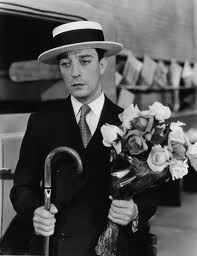
(April Fool’s Day, 2025: a haiku in honor of the Great Stoneface, Buster Keaton.)
The lot of the fool–
a fresh bouquet of flowers
delivered too late.
The hatless pilgrim, roving this way and that, a man embodying the virtues of scat (in every sense of the word), roving through starched cardstock fields in search of an impossible flower and its stingy nettles—proud, pistil-engraved, the flower’s gullet braised by rivets of sungold—(this, how the man warms himself within, how he sounds out his vision, vowel by vowel, word by word, merciless in his measure)—this man, evolving and degenerating all at once, has given himself many names—Murphy, Molloy, Malone, Mercier, Camier, Watt, Krapp—nomenclatures in a fishless glass bowl hosting myth and metaphor (some may say madness), the hatless pilgrim ambulating forlornly around placeless terrain, picking up a bruised metaphor here, putting down a scratched symbol or curlicue there, basically, a scavenger versed in vaudeville metaphysics, a ragpicker of the abstract, and master of zero sum instigating a fool’s mission through slates of Braille and algebraic ruins.
We pause. End of Act I.
Act II: We open with the man needing to redress his scarred self in the clothes of a new name. I ask him what it will be. It’s already been Watt, he snides acidly. Mum’s the word. Mum’s the claw and birthing metaphor too. It seems Mum covers a lot. We rejoin the mummified pilgrim already in progress, as he enters a tavern, sits his wind-wearied haunches down on a rickety stool, orders a pint of Guiness, allows his hawk-eyes to do their ravening: men everywhere, soiled, tired, flatulent, fatherless (or fatherstruck, or fatherhunted), Mum’s the word as these men gather to groan and toll haunted bells and tell sorted tales akin to coals raked over dying fires. He absorbs them as mollusks would seawater. Glug glug glug. Guiness done. He asks for music. Not aloud, in his head, Music please, and he hears the faint trembling strains of a Viennese waltz, and he is with her again, twenty-toed and entwined, they whirl somatically while making static love to each other with slug-set eyes. Achhhh, disgust, he spits on his shoes, and is immediately expelled from the music-memory. Back at the tavern, he orders another pint, glup glup glup, done. The men remain a time-doped and disordered quadrant of jittery constellations. Where the hell are the meteors, he slams his hand down upon the counter of his mind. Ouch, he winces, orders another pint, glug glug glug, and the night goes on like this, undivided, matching whittled silence to countless confessional days on end.
A hatless pilgrim,
roving this way and that,
a man embodying the virtues of scat
(in every sense of the word),
wandering through starched cardstock fields
in search of an impossible flower
and its stingy nettles—
proud, pistil-engraved,
the flower’s gullet braised
by rivets of sungold—
(this, how the man warms himself within,
how he sounds out his vision, word by word,
merciless in his measure),
this man has given himself many names—
Murphy, Molloy, Malone, Mercier, Camier, Watt, Krapp—
nomenclatures in a fishless glass bowl of myth and metaphor
(some may say madness),
the hatless pilgrim
wandering forlornly around placeless terrain,
picking up a soiled metaphor here,
putting down a scratched symbol or curlicue there,
basically, a scavenger versed in vaudeville metaphysics,
a master of zero sum
instigating a fool’s mission through algebraic ruins.
We pause. End of Act I.
Act II: We open with the man
needing to redress his scarred self
in the clothes of a new name.
I ask him what it will be.
It’s already been Watt, he snides acidly.
Mum’s the word. Mum’s the metaphor too.
It seems Mum covers a lot.
We rejoin the mummified pilgrim
already in progress as he enters a tavern
sits his wind-wearied haunches down
on a rickety stool
orders a pint of Guiness
and allows his hawk-eyes to do their ravening:
men everywhere, soiled, tired, flatulent, fatherless
(or father-struck, or father-hunted),
Mum’s the word as these men gather
to groan and toll haunted bells
and tell sorted tales akin to coals
raked over dying fires.
He absorbs them as mollusks would seawater.
Glug glug glug.
Guiness done.
He asks for music.
Not aloud, in his head, music please,
he hears the faint strains of a Viennese waltz,
and he is with her again,
twenty-toed and entwined,
they whirl somatically
while making static love
to each other with slug-set eyes.
Disgust ejects him from the music-memory.
Back at the tavern
he orders another pint
glup glup glup
done—
the men remain
a time-doped and disordered
quadrant of jittery constellations,
where the hell are the meteors,
he slams his hand down upon
the counter of his mind,
Ouch, he winces, orders another pint,
glug glug glug
the night goes on like this
matching whittled silence
to countless confessional
days on end.
A hatless pilgrim, roving this way and that,
a man embodying scat
(in every sense of the word),
wandering through starched cardstock fields
in search of a stingy flower,
proud, pistil-engraved,
the flower’s gullet scorched
by streaks of sungold
(this, how he warms himself within,
how he sounds it out, word by word,
merciless in his measure),
this man has given himself many names—
Murphy, Molloy, Malone, Mercier, Camier, Watt, Krapp—
nomenclatures in a fishless glass bowl of myth and metaphor
(some may say madness), the hatless pilgrim
wandering around placeless terrain,
picking up a soiled metaphor here,
putting down a bruised symbol or curlicue there,
basically, a scavenger versed in vaudeville metaphysics,
a master of zero sum
instigating a fool’s romp through algebraic ruins.
We pause. End of Act I.
Act II: It’s time for the man to redress
his scarred self in the clothes of a new name.
I ask him what it will be.
It’s already been Watt, he snides acidly.
Mum’s the word. Mum’s the metaphor too.
It seems Mum covers a lot.
We rejoin the mummified pilgrim
already in progress as he enters a tavern
sits down on a rickety stool
orders a pint of Guiness
and allows his hawk-eyes to do their ravening:
men everywhere, soiled, tired, flatulent, fatherless
(or father-struck, or father-hunted).
Mum’s the word as these men gather
to groan and toll haunted bells
and tell sorted tales akin to coals raked over dying fires.
He absorbs them as mollusks would seawater.
Glug glug glug.
Guiness done.
He asks for music.
Not aloud, in his head, music please,
and he hears a Viennese waltz,
and he is with her again,
as they whirl somatically
while making mad porridgey love
to each other with slug-set eyes.
Disgust ejects him from the music-memory,
back at the tavern
he orders another pint
glup glup glup
done–
the men remain
a time-doped and disordered quadrant
of jittery constellations,
where the hell are the meteors,
he slams his hand down upon the counter of his mind,
ouch, he winces, orders another pint,
glug glug glug
the night goes on like this
for countless confessional
days on end.

Convicted sphinx to beguiling raptures,
and time-spanned sync-holes,
literary enigma, Clarice Lispector,
understood keenly the tolling of ruptures
within,
sowing breath’s metered
and fasting threads
to the fractional seethe of holy
and lent.

In lyrical, abetted praise
of Patti Smith,
white witch torchbearer
of punk mettle
and lightning bones—
She, wildly grown
and gutter-starred,
remains in love and swelling thrall
to the Romantic timbre
and clash of Rimbaud’s
unrelenting wake,
or Plath’s penning of dateless verses—
In this respect,
vision, and visionaries,
never grow old or fade,
bur rather stand proof-tested
against Time’s scalpel and ruins,
exacting the plated wisdom of Novalis—
all philosophy is homesickness,
and so it goes, generationally engraved,
the song and the singer
forever mating to heed the marvels
of voice to calling.

Last night I dreamed of Roberto Bolaño.
Or he of me.
We were sitting at a dimly lit café,
a subterranean plot of a café,
and Bolaño was drinking chamomile tea.
In the latter stages of his life
chamomile tea had become his drink of choice
as he permanently disfigured the literary landscape
with a pair of scratched glasses and acetylene torch.
Bolaño’s liver had gone to rot
and would not be making a comeback.
His father had been an amateur heavyweight boxing champion.
I wondered what he would think about his son drinking chamomile tea.
My father had been an amateur boxer, too,
but not a heavyweight, and not a champ.
I figured this was something Bolaño and I had in common.
That, and writing.
But I was too scared to bring up writing.
I knew of Bolaño’s legendary penchant for eviscerating other writers,
ones he thought lowered the bar, and I wanted to stack up,
make the cut, and I cursed out this bilious prick Bolaño
without saying a word to him.
I stared at the man, hunched over,
looking somewhat docile and resigned
as he sipped his chamomile tea
in slow and measured sips.
There was nothing to fear,
I was projecting, creating late night cinema
to keep myself on edge.
Then, a mistake.
I asked Bolaño what he was drinking
(having slipped my mind that I had already asked this)
and he said, without raising his eyes—Chamomile tea, stupid.
Stupid?
I felt my triggers flush and activate.
Fireworks went off in my head: Listen,
you scrawny, green-livered motherfucker,
just because you wrote some novels and poems
and denounced the literary establishment
with a holier-than-thou pedigree
and acidic smugness, just because…
My fireworks fizzled out.
I stared at Bolaño who was contemplating his tea,
a Buddha with a middle finger for a tongue.
Both of our fathers had been boxers,
but whereas his father had taught him how to box,
my father hadn’t taught me.
In that respect, I was at a clear disadvantage
if I decided to physically confront Bolano.
Then again, his liver was bad,
and as far as I knew my liver was functioning fine.
So who wins?
A writer with boxing skills and a bad liver,
or a writing with no boxing skills and a good liver?
I’d bet on Writer A.
I was Writer B.
I wanted out of this nightmare café,
out of this dream.
It represented too blunt of a mirroring system.
I rose to leave.
Bolaño’s eyes tracked me.
You should stay, he said. We can talk about writing.
Wait, Bolaño knew I was a writer
and he wanted to talk to me about writing?
All my venom dissipated.
Bolaño and I were on good terms.
I liked this proud, passionate, self-possessed
tea-drinking writer, whose father had been a boxer.
Just like my father.
There was that, and the writing.
We could potentially talk all night.
Visionaries
elope with themselves.
Time-lapses
of a shotgun wedding
in a placeless tent
ministered by the migrating wind
and its sideshow cabal of voices—
In the company of echoes,
you kneel, and grow favorably intimate
with unheard of distances
closing on your lips.

