Unfinished Nocturne

197729_10150321855500861_2554828_n

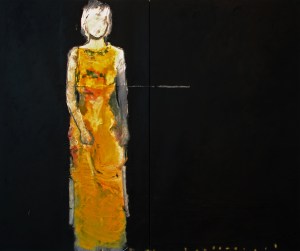
Artwork by Linda Stojak

She is the living embodiment of a nocturne,
a girl who gathers dark and silence from the cave she inhabits.
Or the cave that inhabits her.
She sits, stock-still, a fugitive Buddha quietly gathering dark.
Quietly, but not always serenely. Still waters not only run deep, but also harbor swirls of turbulence. Sometimes, when she appears most calm, or is projecting composure, she is roiling inside.
She carries the dark and silence with her wherever she goes.
There are onyx pools in her cave.
From the bottom of these shallow pools she derives silt, and then converts the silt into a salve. This salve helps her to expand and adjust her perception.
When she leaves the cave at night, she does so to engage the Onyx Priestess, a goddess-wraith that moves like dark charged wind over the landscape.
The Onyx Priestess is the patron-goddess of women psychically disfigured and internally scarred. She casts down stubby luminous tendrils,
like so much spiritual confetti,
like candied benedictions,
and women in need swallow and digest this medicine.
This is how the healing begins. It is a slow healing.
It is the hands of the Onyx Priestess growing inside them,
massaging their core wounds.
The presence of the Onyx Priestess is vitalizing for the girl, a spiritual source from which she draws nourishment.
In this respect the girl’s night-time pilgrimages, abbreviated though they are, are very important to her.
From the cave she gathers dark and silence.
From the Onyx Priestess she gathers the strength and fortitude to ably contain that dark and silence.
My relationship, if you could call it that, with her was brief.
I wanted it to be longer, wanted more, yet she wouldn’t allow me to come between her and her solitary ritual of gathering dark and silence.
The consistent intake of dark and silence was part of her spiritual diet, and necessary to her existence as a Nocturne.
Several times we left the cave for excursions into the daybright world.
As much as she luxuriated in sunlight she knew there was only so much of it she could bear, so much she was able to take in, lest she put the dark and silence at risk. There was a calculated negotiation, a conscientious balancing that went into not only being but remaining a Nocturne. If that balance wasn’t maintained, she would dissolve and fade, as if she had never been there at all. Many other Nocturnes has gone the way of oblivion. In a sense, they were an endangered species, or a breed that operated from a place of lingering peril.
There was even a reminder scrawled in pulsing neon-lime (the ink drawn from a mysterious source in the cave, which she never revealed to me) which read:
I am a Nocturne,
and it is my sacred vocation
to gather dark and silence
I asked her why she wrote that, was she afraid of forgetting?
Yes, she said.
Have you ever forgotten it?
Yes, many times. And I came close to fading. Without rituals, without mantras, it is easy to forget. The world outside is mostly made up of Those Who Have Forgotten.
When I asked her what it was they had forgotten, she said she didn’t know as she was not them.
I wondered if she considered me one of Those Who Have Forgotten, yet decided not to ask. Perhaps I was afraid of being lumped in with everyone else, a tagged collective.
During our excursions into the daybright world she seemed happy. Yet it wasn’t a complete or thorough or full-on happy, it was checked by a reserve, creased with vexation. It was happy underscored darkly. I tried to ignore it. It was like admiring the surface beauty of the sea, enjoying the rhythmical symmetry of its waves, while a part of you remained aware of a malignant undertow. Measureless beauty and mystery, coupled with spells of violence and death, that was her.
It was like dating someone who was the eternal understudy for the role of pall-bearer. Or a widow waiting to happen.
An ending was born after nine months. That’s how much time we got to spend together. Most of it was spent inside her cave. I would bring candles with me and light them.
Sometimes I would hold a candle near her face. The light not only brought her features to life but made them dance.
She didn’t smile often, but when she did, a wordless joy, a luminous underscore.
 I fell in love with her even though I knew she’d never leave her cave for me. Or that the cave would leave her. The two were inseparable, a union born out of a sacred bond that I couldn’t fully understand. What I did understand: I was the third wheel, the extra part, which didn’t fit in with the long-term vision. She never said what that long-term vision was. She wasn’t much for explanations or words piled on top of words. She specialized in silences and epitaphs.
Sometimes we slow-danced in the cave.
We’d slow-dance to no music. We slow-danced to the memory of music, to the possibility of music. Occasionaly, she’d hum softly, vibrate subtly, while we slow-danced. When she hummed it was almost as if the sound wasn’t coming from her but from somewhere inside the cave, a measureless echo, a distance trying to reach itself.
A part of me wanted to stay in the cave with her forever, yet I knew this wasn’t possible. It was not my cave. It belonged to her. She enjoyed my visits, maybe even entertained notions of what it would be like if I stayed there a long long time, but in taking directions from the cave itself, she knew that could never be. The gathering of the dark and the silence was a solitary affair.
The cave was not a habitat intended for two.
Daytime was a flight of fancy, a sweet brief escape, a temporal shift . . . it was all of these things, but it was not a way of life. Not for a Nocturne.
The only ones who could ever truly understand this, she told me, were other Nocturnes.
That’s why she no longer wasted time with explanations, or tried to make herself understood through words. It didn’t work. It was an impoverished form of shorthand. Other Nocturnes understood, implicitly.
I was not a Nocturne. I fell in love with a Nocturne, and therefore indentified, experiencing deep-down resonances with certain hidden qualities. What wasn’t brought out into the light, I felt and could relate to with barbed intimacy. Yet this didn’t make me a Nocturne.
To fall in love with a Nocturne, meant sacrificing a piece of your heart to her cave. Perhaps that piece functions like a stray candle, giving the Nocturne a little more light, or at least the memory of light, in which she could revive and watch old movies to pass the time.
When I found her in the cave I was unfinished. As was she. Nine months later, when we parted, we remained unfinished.
Posted in Artwork, Prose, Uncategorized | Tagged , , , , , , , , | Leave a comment

Silent Voices

Figure 70, 2015
Review of Linda Stojak’s exhibition “Silent Voices.”
“The female subjects comprising Silent Voices seem to exist in a haunted chrysalis state, or embryonic purgatory. Their faces, ashen swabs which are kin to Di Chirico’s faceless enigmas, suggest not only the tragic obliteration of identity but also the potential for rebirth, i.e., a Bardo makeover. Who are these women? Who are they in the process of becoming? What is the nature of their shedding and reconstitution? Lyrical, understated, speculative, and lucidly incomplete, Stojak’s artwork brings to mind a passage from the 14th century Japanese text Essays in Idleness, in which Kenkō writes: “In everything, no matter what it may be, uniformity is undesirable. Leaving something incomplete makes it interesting and gives one the feeling that there is room for growth.”
Read the full review at Riot Material.


Posted in Artwork, Press, Prose, Publications, Uncategorized | Tagged , , , , , , , , , , | Leave a comment

My Grandmother, My Chaplin

chappy m'man
Excerpt from Raking the Dust, honoring the birthdays of my grandmother (April 15th) and Charlie Chaplin (April 16th).
In times of hardship and heartache my grandmother would recite St. Teresa’s Prayer or sing Charlie Chaplin’s “Smile” in a warbly and off-key voice, what sounded like the death cries of a rare and beautiful bird being strangled.
Smile though your heart is aching
Smile even though it’s breaking.
When there are clouds in the sky
You’ll get by.
If you smile through your pain and sorrow
Smile and maybe tomorrow
You’ll see the sun come shining through
For you.
The Prayer of St. Teresa and “Smile” were my grandmother’s aural talismans, which she voiced for herself and others.
A couple of years earlier, my grandmother had been knocked into a coma by her third stroke. I flew back to New York to visit her and brought with me a CD I had made containing different versions of “Smile.” Tony Bennett, Frank Sinatra, Rickie Lee Jones, Barbra Streisand, the instrumental version which had been featured in Chaplin’s film Modern Times (for which it had been written).
Alone in the hospital room with my grandmother, I placed headphones over her ears and let the CD play all the way through. I could faintly make out bits of music coming through the headphones as I stared at the withered and shrunken woman in the hospital bed who had replaced my grandmother. Her right arm, which was slightly bent at the elbow, had coiled in toward her chest and fossilized in that position. The deep hollows of her face gave it the look of a tissue-skinned death mask. Tubes, like transparent worms, seemed to be growing out of her nostrils and arms. Yet the thing that most struck me in telling me my grandmother was no longer my grandmother: her shorn gray hair.
My grandmother was fiercely proud and diligent when it came to dyeing her hair and keeping the gray masked or to a minimum. Over the years I had seen a varying palette of colors. Brown, frost-blonde, caramel, chestnut, burnt sienna, eggplant, but gray was never among them. I remember thinking—If my grandmother awoke from this coma and was confronted with this stranger in the mirror, the first thing she’d do is dye its hair.
Before heading back to Taos I left the CD with my Uncle Eddie and told him to play it for her. He said he would and wound up doing so, every day, religiously.  After nearly four months my family decided to take my grandmother off life support, and everyone was shocked when she survived another six weeks without artificial assistance. In life my grandmother had been a fragile and diminutive woman, who had suffered abuse at the hands of her husband and waged constant battle with spells of depression, but at her core she had always possessed a prizefighter’s resilience, one of those people who refused to stay down or give up the fight.  My Uncle Eddie once told me—There are people who go down Alex.  And stay down.  They don’t get back up.  Your grandmother always gets back up.
I liked to think of my grandmother, this liver-spotted spud of a woman, going toe-to-toe with Death, knowing that the fight was rigged and there was no way she could win, yet giving it all she had as Charlie Chaplin and St. Teresa urged her on.
Posted in Prose, Publications, Uncategorized | Tagged , , , , , , , , , , , | Leave a comment

Birth of a Nocturne

IMG_4180

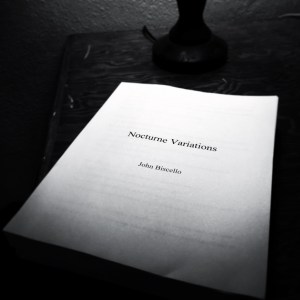
Completed draft of my new novel, Nocturne Variations.
Posted in Prose, Publications, Uncategorized | Tagged , , , , , , , , , | Leave a comment

Spring Dusting

415e9zdflfl-_sx331_bo1204203200_
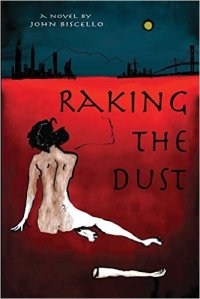
As part of a Countdown Deal, the Kindle edition of my novel Raking the Dust will be available for $1.99, April 11-18.
ABOUT: In this rogue’s tale, full of sound, fury, and erotic surrealism, we meet Alex Fillameno, a writer who has traded in the machine-grind of New York for a bare bones existence in the high desert town of Taos, New Mexico. Recently divorced and jobless, Fillameno has become a regular at The End of the Road, the bar where he first encounters the alluring and enigmatic D.J., a singer and musician. Drawn to her mutable sense of reality, the two begin a romance that starts off relatively normal. When D.J. initiates Alex into the realm of sexual transfiguration, however, their lives turn inside-out, and what follows is an anti-hero’s journey into a nesting doll world of masks and fragments, multiples and parallels, time-locks and trauma; a world in which reality is celluloid and what you see is never what you get.
Posted in Artwork, Prose, Publications, Uncategorized | Tagged , , , , , , , , , | Leave a comment

The Haunting of One’s Self

auster
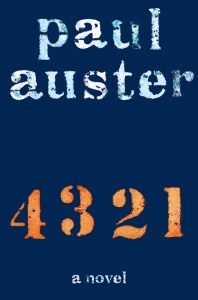
Review of Paul Auster’s 4 3 2 1, appearing in Riot Material.
“He believed in an infinite series of times, in a growing, dizzying net of divergent, convergent and parallel times. This network of times which approached one another, forked, broke off, or were unaware of one another for centuries, embraces all of possibilities of time.” — Jorge Luis Borges, “The Garden of Forking Paths”
One could imagine Borges, who declared that the basic devices of fantastic literature are four-fold—the work within the work, the contamination of reality by dream, the voyage in time, and the double—as personal timekeeper and Virgil-visioned guide to Paul Auster, who for the past half a century has trafficked in existential loops and slipknots, identity crises and vanishing acts. Auster, whether writing fiction or non-fiction, writing in the first person or third person, has always haunted his own writings, sort of as the negative imprint of a splitting point.You could argue that his canon as a whole, comprises a jigsaw autobiography of shadows and illusions, obliquely referring back to its source: an author by the name of Paul Auster who doesn’t exist ( the “I-is-somebody-else” of Rimbaud.) This is his metaphysical stock-in-trade, and in 4 3 2 1, his first novel in seven years, Auster strives to capture it in his most epic manner to date.”
Read the full review here.
Posted in Press, Prose, Uncategorized | Tagged , , , , , , , | Leave a comment

Obscene not Herded

Destiny,
the morningstar,
hikes her dress up high
and pisses a saberlike stream
of light,
honeyed pixels
outsourcing guidance.
Posted in Poetry, Uncategorized | Tagged , , , , , , , , | Leave a comment

Naming Desire

Whoever I am,
I have always depended
on the kindness of words—
such strange company
these solitary verses.
Posted in Poetry, Uncategorized | Tagged , , , , , , | Leave a comment

Bedsores

In the permanent flophouse
Love reigns supreme—
A tried and torn migrant
ready to drop
from chronic fatigue
Posted in Poetry | Tagged , , , , , | Leave a comment

i for an I

Dear Letters of the Alphabet,
We regret to inform you
of the untimely death
of one of your brethren, lowercase i.
Gone missing a while back,
we were hoping for its return
to its rightful place in the alphabet,
but alas,
it could not survive the I-me-mine
culture’s fixation
and dependency upon
uppercase I, a.k.a., the big I.
It has gotten so bad
that whenever it is about U,
it somehow becomes a matter of I,
and if it’ s about ME,
it is still about I,
leaving the poor M and E
feeling flat and not needed.
That being said,
society’s unhealthy obsession
with the Big I
has left us no choice
but to force this vowel
to stand trial.
Whether or not
the Big I is to blame
for its role in the I-centric
attitude and lexicon
of modern society,
I cannot say.
What I can state, unequivocally:
the Big I has grown more and more inflated,
monstrously obscene,
 if you’ll indulge
me a dash of hyperbole,
and as a consequence of this
bloated inflation,
the Big I has suffered a great loss
in both value and meaning.
And so, Letters of the Alphabet,
I’ll conclude my text
by beseeching each and every one
of you to be present at the trial
–remember every letter counts
and holds equal value—
and to please keep alive
the memory of little I,
and let its passing
serve as a grave reminder:
when the last letter falls,
there can be no more
US.
Posted in Poetry, Uncategorized | Tagged , , , , , , | Leave a comment