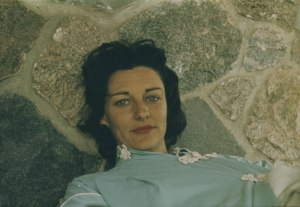
Double Exposure

153pftg
I.
There is strange music in her head,
a choir’s brew.
You cannot see it
but, in the bask of a sunchecked idle,
she drifts beyond ordinary logic
to dream of water
like melted locks,
like aquamarine flowers
silk to the touch
and praising.
II.
She could be Cleopatra on Valium,
calmly awaiting the tragic destiny of asp.
She could be Jackie O. sunbathing in Greece,
far far away from a slow motion drive in Dallas.
She could be Anne Sexton,
having escaped herself in a postcard
dispatched from Cairo or Capri
or Shangri-La, a cursory note
scrawled in haste–
Having a great time without you,
Love, Anne


Posted in Poetry, Uncategorized | Tagged , , , , , , , , | Leave a comment

Morningbreak


981_0089_0060_001
I want to eat
Anne Sexton for breakfast
like toxic cereal
like bacon fat
like sunbursts of egg yolk
swallowed whole and washed down
with a glass of fire
(then I will spit up the flames
burning down the kitchen
until there is nothing left
but ash and cinders
and family secrets
exposed)
I want to eat
Anne Sexton for breakfast,
lunch and dinner, all of her,
the heels, the sorrow, the rouge,
the blue eyes, the cigarettes
and Martinis, the jangly bracelets,
French perfume, and suicide watch,
the frayed ends
and moths that died
clinging to her chest
and closet,
I want to love her a little,
grope and nuzzle and drizzle,
trace the children lost
in her hair and constellations,
call her Annie or Miss or Mother,
and if she wants to love me back a little,
if she wants to eat me in return,
great
but it’s not necessary
I need to be the one eating her
so I can become a witch
and she-wolf and gravity-babe
and dirty my clean silver spade
by moonlight
in someone else’s
cold and remote grave.
Posted in Poetry, Uncategorized | Tagged , , , , , , , , , | 13 Comments

Vivaldi in Love

Spring,
tender bud
raising gravity
in the center
of a palm.
Summer,
drawn and quartered
shafts of light
mouthing the sea.
Fall,
fetal leaves
curling in on themselves—
inversion
banking on faith.
Winter,
hospitable merger
of bare limbs
relishing arson
and lace.
Posted in Uncategorized | Tagged , , , , , , , , , | Leave a comment

Cloud Nine

Dylan Thomas falls
from his barstool in Heaven—
God, tending bar, picks him up,
turns to Job—Who am I to judge?
Posted in Poetry, Uncategorized | Tagged , , , , , , , , | Leave a comment

Lighted Window Syndrome

lighted-window

   All my life I have had lighted window syndrome.
   Being outside someone’s window at night, and seeing the lighted window, its warm amber glow was an invitation to feel a sense of home, not to be at home, but to feel at home, and yet to remain a stranger, in a position of intimate remove.
   It was important to be near yet not in, because that left essential space for my imagination to participate, for speculation to arise. Imagination needs space to create and conjure. It understands the need for sufficient detachment, just enough neutral remove, a calculated distance. Too much and you went cold in all the wrong places, too little and you lost necessary perspective.
   Outside the lighted window I could fully engage my emotions in ways that I could not it if I were on the other side of that window, inside the house. One was a lucid dream-state, the other a state of reality, an actuality. To be inside the house meant to destroy something. Destroy what, exactly? The illusion, the ghost, the fiction. To be there and to not be there at the same time was always my goal, my dream. I suppose writing has allowed me to achieve this in a certain way.
   The lighted window—a lovely haunt, a symbol of purity, an incorruptible dream, a portal to other worlds, but mostly and always a sense of home where my spirit and mind go, and the rest of me is left behind (and happily so).
Posted in Prose, Uncategorized | Tagged , , , , , , , , | Leave a comment

My Sister

   My sister and I are bonded in that we were in the trenches together. In the battle-zone that was our household, we were witnesses to and casualties of the same war.
   I am six years older than my sister. She arrived a little bit later in the war. She missed the early battles. Yet the thing is, memory-wise, she missed some of what she actually was there for. That is, when I talk to her about our childhood, she doesn’t remember a lot of it. She said it’s like a fog, she looks back and there’s nothing there, nothing she can clearly see.
    I remember our childhood as violent, unstable, crazy, memories heated to point of blistering. My sister doesn’t remember it being that bad. I then wonder, with my penchant for dramatization and exaggeration, did I blow the whole thing out of proportion? A part of me needs it to be as scary and fucked-up as I remember it. Otherwise I feel some validity is lost, that my claims are the product of a faulty mind wired for fiction.
   Then I reflect, and while yes I am prone to dramatization and exaggeration, I also clearly remember certain events and episodes that were the seeds of terror and turmoil.
   My sister said she remembers very little about her childhood. Almost as if it hadn’t happened. I remember much about my childhood, and have spent a lot of time reimagining it. My childhood became the primary material I mined and converted into fiction. My sister didn’t mine or convert, she allowed her childhood to be swallowed in memory-devouring black holes.
  My sister does vividly recall a specific incident of terror, in which my father, blitzed out of his mind, chased her and my mother down the block with a knife, and my sister and mother hid in the doorway between a couple of stores on the avenue.
   My sister and I talk about this memory and laugh about it. When we swap other memories of a similar nature, we laugh about them too. It is the laughter of people who have gone through something together, who understand that the laughter is a salve, a release, a comfort, derived from sources of terror and anxiety. Laughter, born of fear, helps to dispel fear. It is the offspring that destroys its maker.
   When my sister was younger she always wanted me to play with her. She would dump out her Care Bears or Strawberry Shortcake figures and ask me to play. Which I did. My sister, unlike me, hated playing alone. I loved playing alone, creating my own world with my action figures in which everyone and thing from reality was excluded. My sister always wanted to play with another person, to be alone and playing did not sustain her interest, nor did it bring her pleasure.
   There was also a game we played called The Wizard of Oz. Basically, all we did was go under a sheet or blanket, eclipsing our “surface reality” as we entered the land of Oz. I’d become different characters, guide the action and narrate our adventures. I think what we both enjoyed most was the fact that we were hidden, that we were cocooned inside a magical world where reality couldn’t touch us.


Posted in Prose, Uncategorized | Tagged , , , , , , , | Leave a comment

My Mother

   My mother had had a hard life. There have been many challenges, many obstacles, and in a sense you could trace their origins back to her father, her rapist.
   When your father is also your rapist your childhood is poisoned at the center, contaminated at the core. And from there growth is irregular, perverse, distorted. Growth no longer occurs naturally. Inversions stage a revolt, or suppress a revolt.
   My mother’s father was her rapist, her jailor, the keeper of the keys to the dungeon in which she was locked. I don’t know much about him. What I do know is that I’ve never heard anyone speak a good or kind word about him. He was regarded by everyone in the family as mean-spirited and miserable, a cheap, petty, and malicious man.
   He seems to fit the profile of a one-dimensional villain, in that he wasn’t even a rapist and child abuser who, on the surface, was a friendly or nice guy, he was an asshole and a rapist. What qualities, I wonder,  if any, redeemed him as a human being?
   My mother got married and had a kid, me, when she was eighteen. My father was seventeen. My mother and father decided to prematurely enter the world of grown-ups, and my mother escaped from her dungeon into a fire-pit. My father had a drug and alcohol problem. Our household was torn apart by squalls, violence, accusations, threats. Everything except peace, never ever peace. “Peace” in my house equated to tense jittery respites, undercurrents simmering and bubbling, until the next blow-up, the next battle.
   My mother was married to my father for seventeen years. She left him many times, when we—me, her, and my sister—would move into my grandmother’s. These trips were advertised as permanent, yet they usually lasted anywhere from three days to two weeks. After leaving my father “for good” for what felt like the thousandth time, eventually one of those times stuck, and became the true and lasting end-point my mother had been building toward for years.
   For the first time in my life my mother was on her own, with her two kids—I was fourteen at the time, my sister eight—and she did what she could to keep us afloat. Welfare, food stamps, a waitressing gig at a bingo hall, while returning to school part-time to work toward a teaching degree.
   If my mother didn’t say I love you enough, or at all, when we were kids, she actively demonstrated that love by taking care of us, making sure there was food to eat, that we had a roof over our heads. She loved through action, though I didn’t recognize it as such or appreciate it back then. Then came the contaminated backwash of memories that had been blocked, that had been dammed from her consciousness since she was a child. Memories of her father’s sexual abuse came back to my mother and sent her into an emotional and mental tailspin.
   There was the day she lapsed into a fugue and walked back to her childhood home as if she still lived there, there were the pills, there was the suicide attempt.
   My mother began the work of directly addressing the ghosts and demons of her past. She did this determined to heal the shame and hurt which poisoned her insides.
   I always tell my mother I’ve had two mothers. The one who was married to my father, and the one who came after the divorce. The second one put in time and effort to reclaim vital parts of her soul, to restore herself to herself, and to this day she continues that kind of soul-work. Whether she sees it or not, she has exhibited bravery, she has been a fighter.
   My mother is now sixty one years old. She has been diagnosed with a rare form of lymphoma (Waldenstrom Macroglobulinemia). She has good days and bad days. Her body is starting to betray her, sometimes subtly, sometimes in more pronounced ways. Sometimes I feel sorry for my mother, I feel pity. I feel as if her life has been a struggle from the very beginning, she was robbed of her childhood by her father’s malignancy, and there have been many battles, struggles, and disorders between then and now.
   I do not want my mother to wither away, with so much life inside her still unlived.
   Live, live, I want to scream, as if my rage will work as a spell, a difference-maker.
   Live, live, I want to shake the disease from her body, her bones, want her once and for all, even if just for a brief while, to be free of all malignancies, to know what it feels like to live beyond shackles and contamination.
Posted in Prose, Uncategorized | Tagged , , , , , , , , , , | Leave a comment

My Father

My father was a tough guy. How tough, it’s hard to say. And when I say tough I mean it in the street-Brooklyn sort of way. Neighborhood-tough, man-tough, like that.
   As I’ve grown older I’ve realized it’s much more powerful to be strong than it is to be tough.
   Anyways, when I was a kid my father seemed invincible. Like a bullet-proof action hero. I’m pretty sure my father also saw himself in that way. He needed or wanted to believe it. Nothing or no one could hurt him.
   My father lived recklessly: drugs, drinking, gambling, wild nights. His reckless lifestyle led to fights, car accidents, jail, hot-water situations, wars with my mother. From these situations he always walked away, if not entirely unscathed, then in good enough shape. Nothing that happened to him slowed him down, altered or reversed his course, he plunged ahead with reckless abandon.
   As a child I didn’t consider my father’s inner landscape, what might be going on inside him, what haunts and scars, what demons drove and compelled him, what small deaths he suffered unseen. My father’s inner life wasn’t my business.
   My friend Anthony used to say—Nothing will ever to happen to your father, he’s got the Glow. You have it too.
   Anthony believed that my father and I both possessed what he called the Glow, and because of it we would always manage to skate around consequences, that we’d always land on our feet. I liked thinking that. It felt good to imagine that there this was this Glow, which we did nothing to earn, that would protect us and pardon us from difficult circumstances.
   My father often said someone or thing was watching over him. He liked to believe it was his mother, whom he adored and was adored by.
   I felt small and powerless as a child. Especially in the face of my father’s rages and tongue-lashings, or in the riot of storms that passed between him and my mother. My mother would sometimes call upon me to protect her—John, John, he’s going to kill me, help me, she’d scream—and she’d place me between them, the flesh-and-bones buffer that she hoped would soften my father’s rage, give him pause. In that respect, my small powerlessness functioned as a useful tactic.
   I saw my father as a monster and a god. Whatever fear and anger I felt toward him was superseded by awe, by my wanting to be like him. He was one of the “cool” dads on the block, because he was wild, he embodied the spirit of rock n’ roll, he was the rebel with no causes of which to speak.
   He drank, did drugs, listened to Led Zeppelin, The Doors, Pink Floyd. When blitzed out of his mind he would crank up The Doors and sing along at the top of his lungs. He idolized Jim Morrison, whom he referred to as Big Jim. I grew up absorbing the spirit and fury of Big Jim, the dark musical carnival that was The Doors. They are the band I most associate with my childhood.
   A lot of my friends’ fathers didn’t possess the same adolescent fervor of spirit that my father did. Or if they did, they didn’t showcase and exhibit it in the same way.
   My friends were scared of my father. I was scared of my father. My father acted as if he wasn’t scared of anything, which probably meant that he was scared of a lot. Massive egos do a helluva job in hiding fears and defects.
   My father, the four-packs-a-day smoker of Kools, guzzler of Budweiser and Heineken, my father, the rogue absentee who sometimes disappeared for days on end during his drug-and-booze-fueled binges, my father, the gambler who blew through money as if it were so much confetti, my father, the monster, the god, my father, the tough guy, the wounded, the fallible human being who harbored small secret deaths of which he never spoke, which impacted an inner life about which I knew nothing at all.
Posted in Prose, Uncategorized | Tagged , , , , , , , , | Leave a comment

Manual Labor of Like

   I had hoped to make out with Josephine during the movie, but the hand-job was completely unexpected.  Even after what Kenny had told me, I was still shocked when it happened.
   Josephine was the cousin of Jenny, my friend Kenny’s girlfriend.  Josephine lived in Far Rockaway, but during the summer she spent a lot of time at Jenny’s house.  Kenny told me that Josephine had told Jenny that she liked me, and did I want to hook up with her?  Kenny also told me that Josephine would do things to me.  I was fifteen and except for making out with Maria Ciaponne when we had gone on a date (also to the movies) the year before, I had not had things done to me.
   What things, I asked Kenny, who smiled and said—Things, you know things—then simulated one of those things by rapidly moving his hand up and down near his mouth and pushed his tongue against the inside of his cheek so it bulged outward.  Things, he said again, and slapped me on the back as if I were the luckiest boy in the neighborhood.
   Josephine and I decided on a double-date with Kenny and Jenny at the movies.  We went to see Police Academy III and sat three rows from the back.  Five minutes into the film, Josephine’s hand gloved mine and stayed like that for a few minutes, then slid snake-like between my legs and went for my zipper, which was no match for her expertly nimble fingers.
   Her warm, tiny hand vice-gripped my penis—the first time it had ever been held in that way by anyone except me—cutting off the flow of blood, then her grip slackened, allowing the blood to resume its regular circulation, and my erection was instantaneous.
   I remember that the black actor who would make all sorts of funny and crazy sounds was on-screen, imitating a helicopter or something, and Jenny and Kenny were both laughing hard and Kenny, who was seated to my right, nudged me on the shoulder and said—This motherfucker’s funny as fuck—and in a low voice I agreed—Yea he is—as Josephine’s hand rapidly and effectively finished me off in less than a minute.
   I wasn’t sure if Kenny was aware of my climatic body-spasm as I came in my boxers and into the palm of Josephine’s hand.  My vision, which had gone fuzzy, and my heart, which had been beating at an accelerated pace, both returned to normal functioning.  From the corner of my eye I saw Josephine wipe her semen-sticky hand on her jeans, then she turned to me, smiled, and parted my lips by thrusting her tongue into my mouth.  After withdrawing her tongue, she stayed close to my lips and whispered, as if wanting to speak the words directly into my mouth—I like you.
   There it was, straight from Josephine’s lips.  I was a liked man.
   Look at these two, Kenny said to Jenny—They’re already kissing.
   Jenny laughed, as did Josephine, who said—You know me, I move quick—then looked at me and winked.
   If this is what she would do to me in the theater, what would she do to me out of the theater, I wondered, and conjured all sorts of fantasies, none of which would come true.


Posted in Prose, Uncategorized | Tagged , , , , , , , , , , | Leave a comment

Kleptomania


   There was a time when kleptomania was all the rage among the women in my family. That is, my mother, and my two aunts, Marie and Rosetta, were robbing department stores and toy stores with casual regularity. I’m not sure how long it lasted. Maybe three or four years. What I do remember is that we kids—there were six of us total, each family had a boy and a girl—received whatever gifts we desired for our birthdays and for Christmas. No item was too expensive. So long as it would fit inside a large handbag or the oversized coats that the women wore when stealing, it could be ours.
   Marie was the ringleader, in that she had been robbing the longest and was by far the most brazen of the three. I remember the time we were in Macy’s and she stuffed a box containing a small stereo inside her coat and walked right out of the store, without batting an eyelash.
   My mother and Rosetta grew slightly bolder as their careers progressed, but they never came close to matching Marie’s level of ballsiness.
   The families, during Christmas, would exchange gifts and the underside of all our Christmas trees would be overflowing with presents. Suffice it to say, we kids became spoiled. We expected to receive whatever we put on our lists. We briefly experienced a Golden Age, a Gatsby era of stolen toy excess.
   I’m not sure why my mother stopped stealing, but eventually she did. As did Rosetta. Marie kept at it. Which now meant all the best gifts came from her. This pissed my father off. If I were to open a gift and say, Wow, it’s a G.I. Joe Battle Van or the Millennium Falcon, my father would caustically remind me—Yea, don’t forget that it’s stolen. He denounced Marie as a thief and a lowlife, and wanted to make sure that my sister and I understood that the gifts we received from him and my mother were paid for.
   I, personally, never cared how the gifts were obtained, I just enjoyed receiving them. Robbed, purchased, whatever, it was all the same to me. I suppose, to an extent, that attitude carried over into my adult life. Legal, illegal, fair, unfair, honest, dishonest, to me they were all mutable terms in a world made of fiction. Maybe because theft, lying, cheating, and hustling, weren’t just part of my family tradition, but also core principles, or lack thereof, in my neighborhood. You did what you could to get what you wanted.
   It was an unspoken custom, a commonly accepted way of life. Work the angles, get over on people, don’t let people get over on you, do the wrong thing just don’t get caught.
   My neighborhood very much operated according to the creed: It is easier to ask for forgiveness, then it is to ask for permission.
Posted in Prose, Uncategorized | Tagged , , , , , , , , , | Leave a comment