
On the day
I was turned to stone
all mirrors were instantly
abolished and silence
became that gilded golden thing
I had heard so much about
and the stillness of time
slowed to a moist chafing
pardon
where I was excused
from the unbearable lightness
of being a human
minding gravity.
I don’t think they can handle the Juice, Davey Dog sneered a challenge.
He smirked with superiority and you couldn’t tell exactly where he was looking, because his eyes were hidden behind dark glasses.
There were eight of us gathered in his basement, four boys, four girls, all between the ages of 15 and 17. The Dog’s basement was a safe harbor where we could drink and use drugs without worrying about getting busted.
Davey Dog was my friend Joe’s brother-in-law. He was in his late thirties and worked as a driver for Wise potato chips, which meant there was never a shortage of chips for us to much on.
Dave wore dark glasses whether inside or outside. I had only seen his eyes several times, and didn’t like that they were vacant and overcrowded all at once.
Dave spoke with a self-consciously cultivated drawl, a stoned surfer and hipster burn-out rolled into one. It was a voice that he often “blackened up” for maximum effect. Perhaps he had dreamed of being a jazz hero, some kind of midnight falcon or hawk, but he was a driver for Wise potato chips who drank like a fish and did a ton of drugs and liked having young people around who he imagined looked up to him as some sort of Vice Den Messiah.
Which was how Joe saw him.
Joe had grown up in a traditional Italian family, a family of immigrants, and when Dave married Joe’s sister, Linda, it was like American coolness had infiltrated their lives. Dave was a self-heralded rebel in ways that greatly appealed to Joe’s imagination.
On this night we were all drinking beer and most of us were tripping X. We sat and ate chips and lovingly insulted one another, and at one point Joe turned to Dave with a smile and said—Tell em about the Juice, Dog.
Dave smiled and held it until it became a hard, unnatural thing, then cautioned—Man, I’d better not even talk about that stuff.
Dave swigged from his beer, and Joe went on, as Dave knew he would—The Dog has this stuff, this juice you drink, and . . . man, I had the smallest amount the other night, just a little, and I was gone.
Dave, like a proud mentor, picked up where his pupil had left off—Dude couldn’t even walk. His legs were jelly.
Dave hissed laughter through his nostrils while clapping his hands riotously. Joe did the same and affirmed—I was jelly, man.
Let us have some, Dominic pressed.
Yea, don’t hold out, Anthony pitched in.
That’s when Dave had said to Joe—I don’t think they can handle the Juice.
The gauntlet had been thrown. Several of us scrambled to pick it up, prepared to transform ourselves into jelly.
After a bit of mandatory pleading on our part, Dave went to the closet, opened it, and just then Linda appeared on the steps leading into the basement. She was at about the halfway point and poked her head out in our direction, surveying the state of the basement and its occupants.
Everything good down here, she asked, looking at us then at Dave.
Yea, Lin, everything’s fine, we’re just shooting the shit.
Her voice grew clipped and took on worry—You know you shouldn’t be drinking down here.
She turned her gaze on her brother—And what about you Joey? Are you drunk?
No, Lin, I’m not drunk. Stop acting like mommy.
Before Lin could respond Dave cut in—Lin, isn’t it better that they’re down here, in a safe place, than out on the streets? There ain’t no cops here.
Linda bobbed a nod, as if agreeing, but said—They shouldn’t be drinking at all. They’re kids, Dave. They shouldn’t be getting drunk.
Dave responded in a calm, paternal voice—Don’t worry, Lin. I’m keeping an eye on them. I’ll make sure they’re alright.
We, the kids, remained frozen in the glare of Linda’s implication.
Don’t stay up too late, she told Dave, then ascended the stairs.
Dave smiled and turned to Joe—Your sister’s a real watchdog.
Tell me about it, Joe agreed.
Dave went into the closet and took out a plastic jug filled with clear liquid and poured what was equivalent to mouthwash gargle amounts into paper cups.
Start with that and see how you feel, Dave spoke like a doctor prescribing medicine.
Me, Dominic, Anthony, Joe, Kim, and Kristine had some. Janine and Mary passed.
I drank what had the texture of syrup and pretty much no taste at all.
What is this stuff, I asked Dave.
It’s medicine to help you relax, Dave responded coyly and dosed himself.
We each had a second round and before drinking Dave warned us—Remember, you drink too much of this shit and you won’t be able to walk.
Then he laughed, perhaps perversely relishing the notion of us as cripples.
Me, Dominic, and Kristine went on to dose a third time, the others stopped at two. It wasn’t long before it felt as if my entire face and body were wrapped in warm, fuzz-coated cellophane. Cellophane that pulsed and produced feverish tingles.
Everyone seemed to be more or less in a state of happy plasticity. Except for Kristine, who shifted from gelatinously relaxed to motor impaired. Her movements had become palsied and she couldn’t focus her eyes. She fell twice. Her enunciation had become syrupy and clotted.
Dave grew concerned. He pulled me and Joe off to the side.
You’re gonna have to do something with this girl, he spoke with low gravity. Your sister’s upstairs and . . . I can’t have this bitch dying in my basement.
She’s not gonna die, I snapped with assurance, yet felt alarmed that Dave had even raised the possibility.
She’s your girlfriend Johnjohn, do something with her, Dave said.
She’s not my girlfriend, I shot back.
Well that bitch wants to jump your bones, I can tell you that much, Dave said. Just cuz you’re too much of a homo to do anything with her…
Dave smiled and cupped the back of my neck, letting me know that his remark was meant as encouragement and not as a slight.
What do you want me to do with her, I said to Dave.
Just then, as if she had been privy our conversation, Kristine called out—Johnjohn, will you come with me to the bathroom. Will you? Please?
I saw Kristine slumped against the wall, Janine by her side, rubbing her shoulder.
Johnjohn you should go with her, Janine urged maternally.
And you’re telling me the bitch doesn’t want you, Dave grinned like a pair of evil scissors.
I walked over to Kristine. Janine gave us space.
Let me lean on you, Kristine said.
I tucked my hand into Kristine’s armpit and guided her into bathroom, closing the door behind us.
She immediately dropped to her knees and began puking into the toilet, a lot of it splashing onto the toilet seat, which was down. I came in from the side and flipped the toilet seat up, wanting to be useful in some way. Kristine retched violently, her body convulsing. I rubbed her shoulder as I had seen Janine do.
Eventually Kristine finished and lifted her head from the toilet. Puke moistened her mouth and the edges of her long dark hair. I tore off strips of toilet paper and handed them to her.
Your mouth., I said.
She wiped her lips and her mouth.
Did I get it?
Yea. There’s also some in your hair.
Help me stand, she said.
I took Kristine’s arm and helped her to her feet.
She stared into the medicine cabinet mirror.
I can’t even see myself, she said. My vision is out of whack.
Am I here, she asked, and laughed a soft, curdling laugh.
You’re here, I assured her.
I pinched her forearm.
Feel that?
No, she responded.
I pinched my own forearm.
I can’t feel it either, I said. Guess we’re both not here.
We’re ghosts, Kristine smiled. Then—Can you help me clean the puke out of my hair?
Sure, I said.
I turned on the water, regulating it until warm.
Tilt your head to the right, I guided Kristine. A little lower. Good.
I placed the puke-stained strands of hair under the running water.
The feel of Kristine’s hair along with the warm water threading between my fingers put me at ease.
I asked Kristine to switch sides and tilt left and continued washing.
When I was done I grabbed a towel from the towel-rack and dried the ends of her hair.
Good as new, I told her.
You’re a great beautician, Kristine smiled, then looked into the mirror—I still can’t see myself. Not clearly. I’m a smudge. You’re a smudge too.
We’re impressionistic, I said.
Yes we’re, Krsitine brightly started, then stopped, and looked into the mirror, perhaps to verify the substance of her impression. Then she turned to me and looked into my eyes in a hazy out-of-focus sort of way, and said—We’re good friends, aren’t we Johnjohn?
Yes K, we’re good friends.
Kristine smiled, as if doped by innocence.
We’re such close friends, she went on, and you like me, right?
Of course I like you.
No, I mean, like-me like-me. Do you like-me like-me Johnjohn?
It was then that our words crossed.
As I spoke—I like you—Kristine suggested—We should have sex—and then we stopped, a couple of ghosts who were still inhabited by their bodies.
You want to have sex now, I asked Kristine.
Yea, now. Why not? We should do it. We like each other and . . . everyone is out there and we’re in here.
We were in here and they were out there, I adopted Kristine’s reasoning. Why not, right?
Don’t worry, Kristine said, I’ll brush my teeth.
You have a toothbrush with you?
No, I’ll do it with my finger.
Which is what she did.
When she was done—Smell.
She breathed into my face.
Minty fresh with just the faintest under-scent of puke.
We began making out.
Tongues, hands, groping, friction, and eventually Krsitine’s jeans around her ankles, and then her panties.
I looked down at Kristine’s panties, which were cream-colored, and noticed that they were splotch-darkened in the center.
Kristine followed my line of vision to the spot and said—I forgot that I have my period. Do you care?
I don’t care, I lied.
I looked into Kristine’s fuzzy eyes, then at the blood-dark spot, to which I was magnetically drawn, and fell into a metronomic tic of a rhythm. Eyes, blood, eyes, blood, eyes, blood.
Maybe now’s not the right time, Kristine said, sliding her panties up past her thighs and around her hips. Next came her jeans, and once again she was fully clothed, the reversal complete.
Thank you for being with me Johnjohn, Kristine said and squeezed my hand.
Of course, I said, and squeezed back, feeling bewildered and grateful.
I stood there, torn between wanting to fuck Kristine and wanting to love her, and couldn’t clearly make out the difference between the two.
After Kristine and I left the bathroom and rejoined the others, Dave, flanked by Joe, pulled me aside and asked—What were you two doing in there?
When I responded that I had washed her hair, Dave cocked his head and squinted—I don’t know whether you’re a homo or a bullshitter.
I told Dave to pick whichever one he liked, not caring enough to let him know there was a third choice which he wouldn’t understand.

It was one of the hot-spots on the avenue. The place where the men hung out every day. It was their church, their sanctuary, their cave, a place where the regular lives went away for a little while. My father and two of my uncles were regulars.
The inside of O.T.B. was a cancer pit. Men were only obscured behind screens of thick cigarette and cigar smoke. The men, and some women, would be huddled together, rubbing shoulders, rolled-up racing forms clutched in hands, stubby pencils tucked behind ears, shuttling back and forth between the betting window and the racing monitors posted near the ceiling, which they would shout and cheer and jeer at during the races.
Some men spent the entire day inside O.T.B., not once stepping foot outside. Others took occasional breaks to loiter on the sidewalk, or grab a coffee or bite to eat at Harry’s Doughnut shop across the street.
My father blew a lot of money at O.T.B. and on gambling in general. His gambling often left us, his family, in hot water. He’s burn his entire paycheck on the horses, and would then scramble to come up with money to pay rent, bills, etc.
He would also steal the rent money, or bill money, which my mother tried to keep hidden, but he had an uncanny knack for being able to discover where it was she had hidden money. One time she hid the rent money in an envelope inside the oven, forgot that was where she had hidden it, and accidentally burned it all up.
My father sometimes stole from me, or rather borrowed, as he called it. If my grandfather had given me money, or if I had received my allowance, I, like my mother, would hide it, but he’d always find it. I think he sometimes reimbursed me, though I can’t clearly remember.
As is the custom with gambling, he mostly lost, occasionally won, and once in a blue moon he won big. The times he won big, he’d come home with gifts for me, my sister, and mother, or would take us out to eat. Sometimes both. These instances, few and far between, did not gain favor with my mother, who had been embittered by the thefts, lying, and desperation that mostly spelled out my father’s gambling career.
I saw how my father’s gambling caused chaos in my family, yet a part of me perversely enjoyed that he was a gambler among the many gamblers that populated O.T.B., they were like a secret fraternity or order which could only be truly understood and appreciated by those who were part of the order. These men, mostly blue-collar workers, found companionship and escape through a common cause, even if that cause was diseased thinking.
When the O.T.B. in Bensonhurst closed in 2012, I felt that the neighborhood had lost a vice-den place of worship, and left holes on top of the holes that these men had been trying to fill.
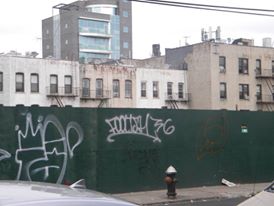
It was a vicious arena, gladiator combat conducted with tongues.
To survive on a Brooklyn street corner you needed you needed to be quick on the verbal draw. It was easy, always on the defensive, one’s metaphysical position was always one of a crouch or coil.
Words were employed as shields and battle-axes, knives and grenades.
And those slow on the take, the “easy” prey, wound up verbally maimed and slaughtered, their self-esteem in tatters.
It was excellent training for a writer, for a storyteller. Not always great for one’s psyche and self-worth, but it did give your skin an opportunity to thicken. Sensitivities were flayed mercilessly, as dialogue like a whirlwind of razors flew around our heads. We talked shit, and lots of it. Silence was un-golden to us, an enemy that might expose our weaknesses.
Go fuck yer mother, was a familial epithet, a barbed strain of affection.
Being referred to as a piece of shit, a retard, a pussy, a faggot, were common phrases in our lexicon, it was the same as saying, pal, friend, chum, buddy, brother.
When I look back on that street corner now, I do so with the affection and appreciation that is born of spatial remove and time-distance. It was a breeding ground, an incubator for stories and storytelling, for performance and a feel for dialogue and timing. And my ability to handle put-downs and criticisms was also born on that street corner. There’s nothing that anyone can say to me that P.J. or Kenny or Petey-Kid didn’t already say, and with slashing vigor. These kids could wound you, pour salt in the wound, and hit you off with a Band-Aid all in one fell verbal swoop.
Hanging out on a street corner, engaged in see-saw battles, furious back and forths, circular rants, helped me. It helped me immeasurably as a storyteller and as a writer, maybe even as a human being. And I learned so much about timing, about the lightning-pulse and beat of comedy, about when to push it and when to pull back, about exercising control over one’s material.
The street corner was the stage for some of the greatest acts and monologues I ever saw and heard, performances that went unrecorded and disappeared into thin air, except I have taken it upon myself, as someone who loves to draw from the secret history of thin air, to pay tribute to these ghosts through the written and spoken word. And so give thanks to the street corner on 64th St and 18th Avenue, and name names—P.J., Kenny, Anthony, Johnny Jaw, Joe G., Petey-Kid, Mike Cheech, and all the others—for no one who finds a piece of themselves, or their spirit, reflected in a story is ever truly forgotten.
The coke parties were my favorite. It was when everyone was happiest. Everyone meant my father, my mother, and their friends, Teddy and Debby. Occasionally, Debby’s brother, Wayne, was part of everyone.
My mother would say—Teddy and Debby are coming over—and I knew that meant a coke party and I got excited.
The coke turned them into children again. Or a peculiar breed of children with waxy glowing faces and eyes full of fire. Not dragon-fire or hell-fire. The fire of all-night magic.
Teddy was a Greek man with two thick dark rugs for eyebrows. Like two baby Muppets had sprouted above his eyes. Teddy loved to laugh. A high-pitched, wheezing laugh, a tea kettle blowing off steam.
His wife, Debby, was the smart one in the bunch. That’s how I thought of her because she was a college graduate. She was the only college graduate I knew. No one in my family had graduated college. Or had even come close. My father had dropped out in sixth grade, my mother in eighth grade. Because Debby was the smart one I always found it odd that she did coke with the others. I suppose I thought college graduates didn’t do coke, that they were too smart or too good for it. Maybe I believed higher education meant a higher quality of living, I don’t know.
Yet I was glad Debby did coke with them, because then everyone was unified in their happiness. The times that Wayne came over, he participated in the happiness, too, but it dampened my joy, just slightly, because something about Wayne scared me. Perhaps it was the stories I overheard him telling, about jail and fistfights and robberies.
The kitchen was where the action took place. As soon as Teddy and Debby entered the apartment, my father would press—Teddy, did you get the stuff—and Teddy, smiling big, would put my father’s mind at ease—Yea, Johnny, I got the stuff—and both men would enliven with anticipation.
Seated at the kitchen table, Teddy or my father would razor-cut lines on a small mirror (engraved with a Heineken logo). I loved the exactitude of the ritual. The methodical dicing of the lines. The plastic straw or rolled-up bill passed around. The vacuum-sucking snorts, and the finicky staccato inhalations draining the residue lining the insides of the nostrils.
My father never let me stay in the kitchen when they snorted. He’d tell me to go into the living room and watch T.V. Fortunately, the kitchen was adjacent to the living room, and leaning against the base of the recliner, “watching T.V.,” I’d angle myself just so and watch them through the open doorway. Yet listening to them brought even greater pleasure than watching them.
The din of their voices, growing bright and electric, the ripples of laughter, with Teddy’s pitch reaching dolphin squeal frequencies.
On those nights they talked and talked and talked, and the warmth that they generated, even if through artificial means, was something I savored and cherished.
It was like being coked-up through osmosis.
Their joy was my joy, their cheer my cheer, their energy my energy.
It was togetherness, albeit a second-rate version, for it only lasted as long as the effects of the drug did. The aftermath of the coke parties, the postscript, bore ruin and waste. When we were all high it was great, the comedowns on the other hand, left us jangled.
In those periods, the magic of childhood dimmed and we darkened and grew old before our time.
Between childhood and death, lay an inclement center which refused to keep still.
As part of a countdown deal, the Kindle edition of my novels Raking the Dust and Broken Land, a Brooklyn Tale will be available for $2.99 from February 8th-15th.
Posted in Artwork, Books, Uncategorized
|
Tagged Amazon, Books, Broken Land a Brooklyn Tale, John Biscello, kindle, Literary, noir, novels, Prose, Raking the Dust, Surrealism
|
Do you know where your children are?
Or rather who, in their ripening pedigree
and new language they are in the process of becoming?
Make no mistake
they are not
nor have they ever been
yours
belonging
infinitely to the green force driving wild shoots
and spleendeep rhythms,
rogue digits
calculating Tomorrow’s petty pace,
they pay no heed
nor praise
to milkwhite coroners
or dead secret gods—
Feral beginners,
brazen and jangled,
they are learning, on a tilted axis,
how to master vertigo
and mend hemhorrages,
how to alter static forecasts
and give the future a fierce makeover.
They do this
claiming the Meek’s inheritance
to fund an Indiegogo Renaissance,
rearing ingrown urges
to become the next generation
of textonal Beats, Bards & Romantics.
Teething on sound, fury
and bright rage,
they don’t need your
Oxford, Britannica
or New Yorker
to define themselves,
to hell with your Webster’s
and Times crossword puzzles,
They have traded in oldschool standards
for a youtube revolution
and ad-free listening to
to hi-def Muses,
pipers to their own call,
they deliver fresh signatures
and encoded cravings
upon cybercentric
walls and posts
beautiful wrecks
of form following function
to blow print runs
and paper hats out
of standing water,
smileyface wink and nod to democracy
is at their fingertips
and screen tested daily.
Pop horror be damned,
they will not turn into braindead zombies
scavenging the earth for slugs and entrails,
their hands far too busy
turning screws and splinters
of discontent
into arias and choral chants.
So I ask again—Do you know where your children are?
Or who in the juggling of pits and seeds they are destined to become?
Make no mistake
with each and every
text, glyph, groove, totem,
riff, rant, image, ballad
and blow,
they are growing
nearer to themselves,
cellular babes toddling bluntly
against the grain,
scamps trespassing a course, uncharted,
their compasses set to Grace.
It was a thing. Every Tuesday night at around 7 or 8, the black Cadillac Sedan would pull up in front of Tali’s bar, and the driver would hustle around to the other side of the car, open the door, and out would step the esteemed passenger. John Gotti.
In the 90s John Gotti was king in our neighborhood. Most of the boys wanted to grow up to be like him. The expensive cars, the three-piece suits, the swagger and moxie, the awe and reverence he inspired. We felt lesser than and we wanted to feel better than and John Gotti was a symbolic bench-mark for high esteem.
On Tuesday nights Gotti would come collect money from Tali’s, a bar in which he was invested. Tali’s was located right up the block from where I lived. I never went in, and you couldn’t see inside because the front door was solid and the windows were darkened. Actually, I did go inside once, I don’t remember why, maybe my father or one of my uncles was in there, and I remember seeing a bunch of old men smoking and playing cards at tables directly across from the bar.
Outside Tali’s you’d often see Italian men, of all ages, loitering, smoking, bullshitting. The front of Tali’s was a Little Italy unto itself.
I could never tell which men were real gangsters and which were wanna-be gangsters. They all looked and acted like gangsters, conducted themselves with a belligerent sense of self-importance and bombastic speech, but I knew, from my father, that many were playing at being a gangster, or hoped to be regarded as such through their shoulder-brush association with the real gangsters.
I have no idea where my father stood in the gangster scheme of things. I knew that he received Teamster magazines, and that he had worked private sanitation for a while (which everyone knew was a mafia-run operation), and he definitely knew a lot of people, but I was never certain if he was on the periphery, on the outside looking in, or close to the center.
Once when I asked him about mafia, he snapped—John, when are you gonna grow up, there’s no such thing as mafia.
Mafia, it seemed, was a fiction on par with Santa Claus and the Tooth Fairy, an illusion that required puncturing as a rite of passage.
Regular people went to Tali’s too. I knew because my uncle Anthony, who was definitely not a gangster, would sometimes go there to hang out. When I asked him what it was like inside there, what went on, he said—Nothing really goes on. The usual bar stuff. People drink, hang out, play cards, shoot darts, that kind of thing.
His banal description of Tali’s dulled the luster of the mystique I had built up in my mind. I imagined there was a back-room where people were sometimes killed. And that the ghosts of those people continued to haunt Tali’s. That big and important deals, determining the fates of various lives, were brokered in a hush-hush manner.
Maybe these things happened, maybe not. By time I was old enough to legally drink Tali’s had closed down and was replaced by an Italian restaurant. Which, as it turned out, was a place where I waited tables for a summer when I was in my thirties. If the ghosts of the brutally slain were still milling about, I never heard a thing.
Posted in Prose, Uncategorized
|
Tagged Bensonhurst, Brooklyn, John Biscello, john gotti, kids, mafia, mob, Prose, story, tali's bar
|
Ready or not, here I come.
I can still hear my voice, calling out, a bright echo in an archival loop.
Hide and seek was a game we used to play all the time.
At my house. Her house. On the block. In the park. Wherever.
She—whose name has gone from me, though I have superimposed many names over the absence throughout the years—always insisted on being the hider. She refused to seek.
You seek and I’ll hide, she’d always suggest with a vigor that implied novelty.
Okay, I’d always agree, as if for the first time.
I liked seeking. It suited my personality. The way, I imagine, hiding suited hers.
In that respect, there was profound ease and harmony between us.
Yet playing hide and seek with her was not like playing normal hide and seek. What I mean is, the length of time she’d remain hidden grew exponentially with each new game, and it became harder and harder for me to find her. And it didn’t matter where we played. Even if it took place in my house, where I knew every possible place in which she might be hiding, I still couldn’t find her. It got to the point where it always ended the same way, me calling out—I give up I give up I give up (for some reason I had to say it three times)—and then she’d suddenly appear, behind me, or to the side of me, as if out of thin air.
Where were you, I’d ask, and her pat response—A good magician never reveals her secrets—underscored by a mischievous smile.
It was when her hiding grew to impossible lengths, that our game became an altogether different beast.
Hours became days and days became months, and I would be absolved of fear and panic and rage and despair only when she revealed herself.
It has now been twenty-seven years since she last hid and never came out.
I have mostly gone on with my life, but a part of me has always remained behind, seeking her, as if the day she went missing froze us both in time.
My wife has told me that I sometimes cry out in my sleep—I give up I give up I give up—and she asks me what it was I was dreaming. I tell I cannot remember, and I think she believes me.
What would she think, I often wonder, if I told her that I used to play hide and seek with a girl who once hid and never came out again? Would her sympathies lay more with the hider or the seeker?
Even though my wife and I have been married for almost ten years, I don’t know the answer to that question, how she would feel, how it might affect her.
What I do know, or rather have come to learn through the interminable length of haunting, is that a game is not truly over until both parties confirm that it is done.
Kenny named her Miss Roach. He named her that because of the stiletto heels she always wore.
Look at them—he’d always point at the heels first, as if she were an extension of the heels and not the other way around—those things are fucking cockroach killers.
Her real name was Kathleen. She was married to a mustached bulldog of a man, Tommy, who sported tattoos and thick gold chains. His muscular arms were usually on display as he often wore white tank-tops, even in winter.
Kathleen and Tommy had two children, Tommy, Jr., and Janine, ages eight and four, respectively. My mother and father were friends with Kathleen and Tommy, who lived several houses down from us, and the four of them would often hang out on our stoop or theirs, shooting the shit and smoking cigarettes.
I was twelve and hadn’t really thought of Kathleen in sexual terms until Kenny christened her Miss Roach. Then I began to see and feel her through Kenny’s hormonally empowered eyes.
Here’s a snapshot illustrating Miss Roach’s trademark look: asphyxiatingly tight denim jeans, Aqua-Net-petrified tower of teased-up platinum hair, oversized gold hoop earrings, a kaleidoscopic blitz of make-up, sequin-studded blouse, and stiletto heels.
Tracking Miss Roach became a thing, a kind of peripheral past-time among me and my friends. Sometimes we’d see her sitting on the stoop, smoking menthol cigarettes. True was her brand. She smoked nervously, rapidly, like a bird pecking at savory air.
If Kenny were there, he would usually spin a colorful narrative as to what he wanted to do to her, and have her do to him.
Other times she’d take off for the avenue to shop, and we’d watch her heel-totter along the sidewalk, with a sort of palsied seductiveness, her denim-puckered ass as the magnetic satellite to which our eyes were drawn.
When it came to the world of sex, Kenny was light years ahead of us, his friends. He had fingered several girls, received a number of handjobs and blowjobs, and had had sex with at least one real girl, perhaps two. Plus, he was the proud owner of an expansive porn collection.
Kenny had been watching porn since he was nine. He was one of those early bloomers of degeneracy.
Porn-viewing at nine, smoking at ten fingering girls by time he was twelve. The rest of us had, at the most, made out with girls, and I hadn’t even done that. It was my secret, burning shame. Demonstrating courage when playing war with my friends was one thing, intimately probing a girl’s mouth with my tongue required a bravery which I seemed to lack.
Anyway, Kenny’s porn collection became the neighborhood lending library for wayward boys. Kenny loved dispending porn to peers in need. I think it made him feel like a mentor or sage, a deprived Obi-Wan-Kenobi to our Jedi-vices.
Through Kenny’s porn I learned about French-fucking, fist-fucking, double penetration, rim-jobs, cum-shots, and more. While I wasn’t able to apply any of this knowledge to my twelve-year-old life, I filed it away for future reference.
The privilege I possessed that none of the other boys possessed—actual contact with Miss Roach. Sometimes she and Tommy would go out in the evening and I would babysit Tommy, Jr. and Janine.
Do you realize that you’re the luckiest motherfucker in the universe, Kenny told me. You get to hang out in Miss Roach’s house. Do you understand what that means?
The blank look Kenny must have read on my face, caused him to squint his eyes and tilt his head, and spoke as if enlightening a mental defective—It means panties, man. Dirty panties. You have access to Miss Roach’s dirty panties.
There he paused, rubbed at the edge of his mouth which had been claimed by a twitch, and his voice grew low and serious when requested—I need you to do me a favor, man.
I knew what the favor was and wasn’t sure I could do it. Kenny, sensing my reluctance, launched, with a great sense of urgency, into a narrative. About how he jerked off to Miss Roach just about every night, and sometimes, in his fantasies, Tommy was tied up and gagged and forced to watch his wife get railed in the ass by a thirteen-year-old. There Kenny stopped, expectancy lighting up his eyes.
And what does that have to do with dirty panties, I asked him.
Kenny scrunched his features together, and again struck the tone reserved for retard edification—Dude, dirty panties could take my masturbation fantasies to a whole other level, get it? I’d have the smell of Miss Roach, the taste . . . I’d be that much closer to the experience of actually fucking her.
The hungry look in Kenny’s eyes and in his voice made me realize that Miss Roach was who and what he wanted more than anything else. His desperate plea for help, for my help, gave me a sense of power. As an avid reader of comic books, with Spider-Man being my idol, I thought of his mantra—With great power comes great responsibility.
It was my ethical obligation to steal Miss Roach’s dirty panties for Kenny.
Posted in Prose, Uncategorized
|
Tagged adolescence, Bensonhurst, Brooklyn, John Biscello, neighborhood, Prose, sex, stilettos, story, urban
|


