
-
Archives
- October 2026
- September 2026
- August 2026
- May 2026
- April 2026
- March 2026
- February 2026
- January 2026
- December 2025
- November 2025
- October 2025
- September 2025
- August 2025
- July 2025
- June 2025
- May 2025
- April 2025
- March 2025
- February 2025
- January 2025
- November 2024
- October 2024
- September 2024
- August 2024
- July 2024
- June 2024
- May 2024
- April 2024
- February 2024
- January 2024
- December 2023
- November 2023
- October 2023
- September 2023
- August 2023
- May 2023
- March 2023
- February 2023
- January 2023
- December 2022
- November 2022
- October 2022
- September 2022
- August 2022
- July 2022
- June 2022
- May 2022
- April 2022
- March 2022
- January 2022
- December 2021
- November 2021
- October 2021
- September 2021
- August 2021
- July 2021
- June 2021
- May 2021
- April 2021
- March 2021
- February 2021
- January 2021
- December 2020
- November 2020
- October 2020
- September 2020
- August 2020
- July 2020
- June 2020
- May 2020
- April 2020
- March 2020
- February 2020
- January 2020
- December 2019
- November 2019
- October 2019
- September 2019
- August 2019
- July 2019
- June 2019
- May 2019
- April 2019
- March 2019
- February 2019
- January 2019
- December 2018
- November 2018
- October 2018
- September 2018
- August 2018
- July 2018
- June 2018
- May 2018
- April 2018
- March 2018
- February 2018
- January 2018
- December 2017
- November 2017
- October 2017
- September 2017
- August 2017
- July 2017
- June 2017
- May 2017
- April 2017
- March 2017
- February 2017
- January 2017
- December 2016
- November 2016
- October 2016
- September 2016
- August 2016
- July 2016
- June 2016
- May 2016
- April 2016
- March 2016
-
Meta
Tracy
Posted in Prose, Uncategorized
Tagged Bensonhurst, Brooklyn, girl, John Biscello, Literary, obsession, Prose, romance, story
Leave a comment
Bones & the Blue
My uncle was a full blown junkie. He was rail-thin, a mongrel with no bite. I liked hanging out with him. He had a sweetness and gentleness to him. He was a soft whisper whereas my father was a volcanic scream. The differences in their personalities matched their drugs of choice: my father, coke, my uncle, heroin. I preferred them high to not high, because when coked up my father was energetic and gregarious, and when smacked out my uncle existed in a state of dreamlike languor.
My uncle lived with his mother, my grandmother. She was and would remain his caretaker until he kicked (which happened in his early forties). My grandmother’s house was two blocks away from mine and I spent a lot of time there. I was always there on Sundays, as that was the day we had Sunday dinner together: me, my grandmother, uncle, mother, and my sister. It was a family tradition. Pasta, meatballs, sausages, salad, Italian bread, then cookies or cake for dessert.
I’d usually go over in the morning and my Uncle and I would watch Abbot and Costello, and play games. Usually Hangman or card games: Rummy 500, Go-Fish, Jacks or Better. My uncle frequently nodded off. Amazingly, he always woke up right before the cigarette that precariously dangled from lips fell from his mouth. Well, almost always. There was the time the cigarette fell from his lips, started a small fire, and burned half the couch, as he remained in la-la land. I wasn’t there, but I heard my grandmother telling my mother about it. They often shared stories about their respective men’s strife and mayhem. My uncle and my father were each running their own course to self-destruction. The women, along with me and my sister, were casualties by default.
My uncle and me would also go to the movies a lot. He’d nod off during the movie, his head either slumped forward or thrown back, mouth gaping, Adam’s apple protruding. If the movie had a sex scene, or a sexually suggestive interaction, I’d masturbate through my jeans. This was when I was 12 or 13, and had become a chronic masturbator. When my grandmother took me to the movies, I was a bit more brazen. Whether she nodded off or not I masturbated through my jeans, and tried to do so covertly. I’m pretty sure she never knew. If she did, she never let on. That was one of my grandmother’s specialties: sweeping things under the rug. She hated confrontation, or dealing with uncomfortable or emotionally complicated situations in a direct manner. She’d sweep everything under the rug. The rugs in her house were swollen humps suggesting a lot of hidden shit. My mother often did the same. It was the family way: keep the dark, diseased, and uncomfortable under rugs, in closets, anywhere except out for others to see. Both my grandmother’s house and my parents’ house were breeding grounds for shame. There are only so many things that can be buried under rugs.
Suicide attempts. Incest. Addiction. Abuse. Mental and psychic disorders.
None of it was ever “discussed.” All of it went under the rug.
I now sing the bones.
Posted in Prose, Uncategorized
Tagged addiction, Bensonhurst, Blue, Brooklyn, dysfunction, family, John Biscello, Literary, story
Leave a comment
My Unreal Family
At times I feel like I invented them, along with the rest of my childhood. Which, in a sense, I suppose I have. They are who they are they are, regardless of my perceptions and analysis, yet I have, at least partly created who they are in relation to me.
There are times when I’ve done everything in my power to erase them as a reality, to distort, deform, and reconfigure them (according to my standards of fiction). If you were to ask me to use one adjective to describe my childhood, my family, I’d say: loud.
I remember living through a loud and noisy childhood.
It was the noise of violence, of fighting, arguments, doors slamming, objects thrown; the noise of threats and accusations. Peace, in my house, was a brief tense respite between battles.
My family was not my family. They were a fiction I had stumbled onto, an invention I couldn’t control. I preferred fictions and inventions that I could control, order, and arrange. My family was fiction-as-reality, and it was a reality predicated on chaos, turmoil and unpredictability. Or rather, predictable unpredictability, the kind you could set your watch to.
I had my room in which to hide and take refuge. I had my books and comic books and action figures and video games, my customary escape outlets.
I built different worlds that were my worlds, not the world into which I had been thrust, the world in which I felt trapped, the world in which I was small and powerless.
If you were to ask me what I most remember about my childhood, how I’d describe it, that would be a term I would use: small and powerless.
In my house, in my family-reality, I felt small and powerless, in the worlds I created I felt powerful and important. Has not writing been that for me? A secret world, among language and symbols and images, among the flotsam and jetsam of memory and imagination, in which I felt not only important but more profoundly myself. Writing is the place where I go to meet me. Or the many variations thereof.
In my unreal family my unreal father would sometimes disappear for a couple of days or more, when he was in the throes of a drug-and-booze binge. In the early going I used to pray—please please please God, don’t let him be dead, let him be alive—it was a plea soul-felt and emotionally charged. As time went on my prayers became less emotional and more pragmatically selfish—please please please God, don’t let him be dead, if he’s dead who will drive me to my Little League games, who will take me to Great Adventure? Eventually I stopped praying altogether as I felt nothing at all, just numbness. Even if it wasn’t true on the deepest level I stopped caring whether he was alive or dead, I was tired of the emotional swings, I wanted off the see-saw. Also, if my father was dead, then he, as a ghost could be resurrected through my fiction, and I could feel more for him than I had felt in real life, I would have access to emotions otherwise blocked. The whole thing was an existential mess.
I have always felt that the only way to reach my father, and myself, was to travel an indirect, and oblique route; I had to “live it slant.” Intimacy, for me, or rather a feel or sense of intimacy, required distance. There had to be a sufficient measure of distance, a space in which the intimacy could grow. I’ve always thought of it as “breathing room.” The distance between reality and imagination allotted the breathing room in which fiction could arise and flourish, in which it could become something real.
Being separated from my family, in the physical, geographical sense, allows me a different perspective on them, on myself, on what is between us (and what is not between us).
I have found much that is alive in ghosts; I have found much love, or if not love then a special breed of warm intimacy, in absence.
Posted in Prose, Uncategorized
Tagged Bensonhurst, Brooklyn, brooklyn spleen, catholic, fiction, Italian-American, John Biscello, Prose, story, urban
Leave a comment
Meaning of the Mob
The Meaning of the Mob. I say, the Mob, meaning the Definitely Uncertain, Fixed—a liberal form of physics—
or the clotted swarm wallforming brick by brick, a mosaic pattern. Pick a number, any number, it’s a given.
A given what, you say, a given that, heads together, mindless, will make of a stone’s throw a hard cold pledge—Indivisible, in Mob We Trust.
Meaning the Mob
made of a stone’s throw a lottery-like contest,
one hurl after the next,
snuffing out solitary skull-candles
in the name of making nameless a victim
swallowed by sand.
And blood. And the song sung not unlike syncopated tocks of rockingchair horror-christened,
the chant a band of hands knotted together:
In Mob We Trust . . . In Mob We Trust . . .
circling the victim,
swallowed by sand. And blood.
And it was black. It was black and they couldn’t see . . . and the track like that of an animal’s . . . they couldn’t see . . . it was black . . . and they couldn’t see . . . the moon—Mack the Knife, the Fat Pope, the Poet’s Dream—blacked out . . . they couldn’t see . . . so it was only . . . natural.
Posted in Poetry, Uncategorized
Tagged america, Brooklyn, civil rights, dignity, human rights, John Biscello, love, mob, mob mentality, Poetry
Leave a comment
Broken Land
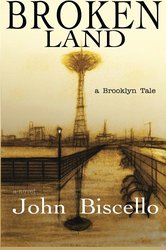
Print edition of my first novel, Broken Land, a Brooklyn Tale has been re-released.
ABOUT: A spectral, existential noir set against the aging irons of Coney Island and old guard lions of hip hop and silent film, Broken Land, a Brooklyn Tale tracks the singular odyssey of would-be sleuth and soon-to-be wordsmith, Salvatore Massimo Lunezzi. Prompted by an enigmatic phone call from a writer-friend claiming to be dead, Lunezzi launches an investigation that leads him to Ghostwriters, Inc., a company selling inspiration to struggling writers through the medium of “ghosting.” From Buster Keaton to Arthur Rimbaud, a boozy and brilliant dwarf to an enchanting femme fatale, Lunezzi is drawn deeper and deeper into the soul of story where fiction and reality inevitably converge.
Posted in Books, Press, Prose, Publications, Uncategorized
Tagged Bensonhurst, broken land, Brooklyn, coney island, existentialism, John Biscello, Literary, neo-noir, New York, noir, novel
Leave a comment
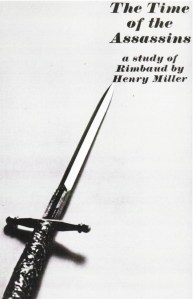
The Time of the Assassins
Review of Henry Miller’s study on Arthur Rimbaud, The Time of the Assassins, appearing in Riot Material.
“Published in 1956, when atomic anxiety and McCarthy-led witch-hunts were all the rage, Miller’s book functions on multiple levels. It is a meditative essay on both the myth and reality of Rimbaud, a hymn to soul-play and self-expression, a whetted scalpel dissecting white-wig morality and ready-made life-wear, and, as always is the case with Miller, a peep-show into the author’s psyche. You could also say that it’s a ticking time-bomb of a spiritual guide, or self-help book with black lung, as Miller summons the verve and electric strain of such prophetic heavies as Blake and Whitman in raising the roof.”
Read the full review here.
Posted in Press, Prose, Publications, Uncategorized
Tagged arthur rimbaud, french symbolism, henry miller, John Biscello, Literary, Poetry, Review, riot material
Leave a comment
Raking the Dust
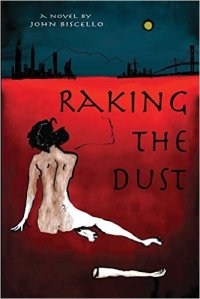
The Kindle edition of my novel Raking the Dust is now available on Amazon.
ABOUT: In this rogue’s tale, full of sound, fury, and erotic surrealism, we meet Alex Fillameno, a writer who has traded in the machine-grind of New York for a bare bones existence in the high desert town of Taos, New Mexico. Recently divorced and jobless, Fillameno has become a regular at The End of the Road, the bar where he first encounters the alluring and enigmatic D.J., a singer and musician. Drawn to her mutable sense of reality, the two begin a romance that starts off relatively normal. When D.J. initiates Alex into the realm of sexual transfiguration, however, their lives turn inside-out, and what follows is an anti-hero’s journey into a nesting doll world of masks and fragments, multiples and parallels, time-locks and trauma; a world in which reality is celluloid and what you see is never what you get.
Posted in Press, Prose, Publications, Uncategorized
Tagged John Biscello, kindle, Literary, New York, novel, publishing, Raking the Dust, San Francisco, Surrealism, Taos
Leave a comment
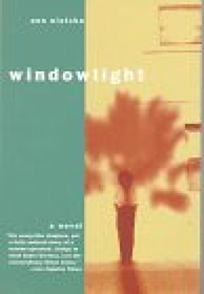
Review of Windowlight
Review of Ann Nietzke’s Windowlight, appearing in Riot Material.
“In many respects a window is a writer’s best friend. It can give the unrelenting “I” a break from inner-space-gazing, extend depth and perspective, offer slice-of-life unscripted cinema, frame the world in manageable portions. It is also the voyeur’s privileged peephole, and this is the spy-glass through which Ann Nietzke covers the whirligig waterfront of Venice, California.”
Read the full review here.
Posted in Press, Prose, Publications, Uncategorized
Tagged ann nietzke, John Biscello, Literary, los angeles, Review, riot material, venice beach, venice california, windowlight
Leave a comment
Inheritance
Amidst divisive riot,
the clear sound of two tears mating
upon the crest of a sunken cheek;
a mother’s grief, near to fasting
and silence, the warmest cross to inherit
in holding the meek inviolate.
Posted in Poetry, Uncategorized
Tagged faith, grief, hope, John Biscello, Literary, love, meek, mother, motherlove
Leave a comment
Winter, a Love Story
Winter’s brides,
wearing long white scarves of sleet and song,
touching pale sky to blue lips,
breathing memory and frost;
their sorrow
and spectral want
grows hands
that enclose me, a robust crush,
matrimonial in its grip,
until I am no more than a whiff of air,
and then, not even that, a traceless speck
unremembered to light,
and how it falls.
Posted in Poetry, Uncategorized
Tagged frost, ghost, John Biscello, Literary, love, white, Winter
3 Comments

