Locomotive

   You didn’t dream her, you who are slowly climbing aboard a locomotive, being watched, so you feel, by whom? The needling press and burn of eyes on your back, itchy hot collar, you scratch, you cough, you take a page from Orpheus, turn back—no one there—you continue boarding the locomotive, the year advertising itself as 1923, but really, you know….

   You didn’t dream her, negative space encompassing worlds within worlds … even now it’s hard to fathom the depths as you tentatively make your way to your seat, foot clumsily thumping the maroon valise of the woman seated in AB, you are AA—excuse me, I’m sorry, you say and smile—AB smiles back—it’s okay…. In your seat, you settle in, consider the long distance ahead, it’s good to finally be in your seat, settled, yes a long distance ahead, you will be even more comfortable when you take your overcoat off, but you will wait, not wanting to disturb the lady in AB, not so soon after….

   You could not have dreamed her, the scent of perfume modeling its tiny stabs therefore olfactory demands—take notice—so you close your eyes, inhale, the immediacy of sweet pangs overlaid with the memory of faraway wife, which compels you to look out the window (your eyes still closed): tall grass, chapped woodsheds, reigning billboards, towers of stacked tires, everything there and then gone, falling behind so fast, time as hybrid zephyr and gremlin—grass, woodsheds, billboards, tires—there and then gone and then repeated differently, same as you aboard a locomotive, 1923, Orpheus, looking back, where did she go, you find yourself dreaming

of the shadow of your hand moving across her skirted thigh, producing fear-based pleasure-chills in your fingertips, ghosts with typewriter teeth, and this lady (AB) and you (AA), find yourselves on track to a most salacious nowhere, hurtling with dewy intent across a country that no longer exists (tall grass, brown milk-freckled cows, scabbed billboards, paint-deprived fences), and in this land of honey and shadows it is her neck, new, that you are kissing … her lips, new, that you are kissing … her breasts, new, that you are kissing … her navel, new, you kissing … it is you, new, because you have slotted yourself in that nubile interstice between dreaming and not dreaming, and aboard a locomotive everything falls behind so fast fading into past, meaning you are always in regressive pursuit of distances that reject closure or attainment,

you who has found your longing a cheat code on the lips of a stranger.  

Posted in Poetry, Prose | Tagged , , , , , , , , , | Leave a comment

Lucky 13 in Long Beach

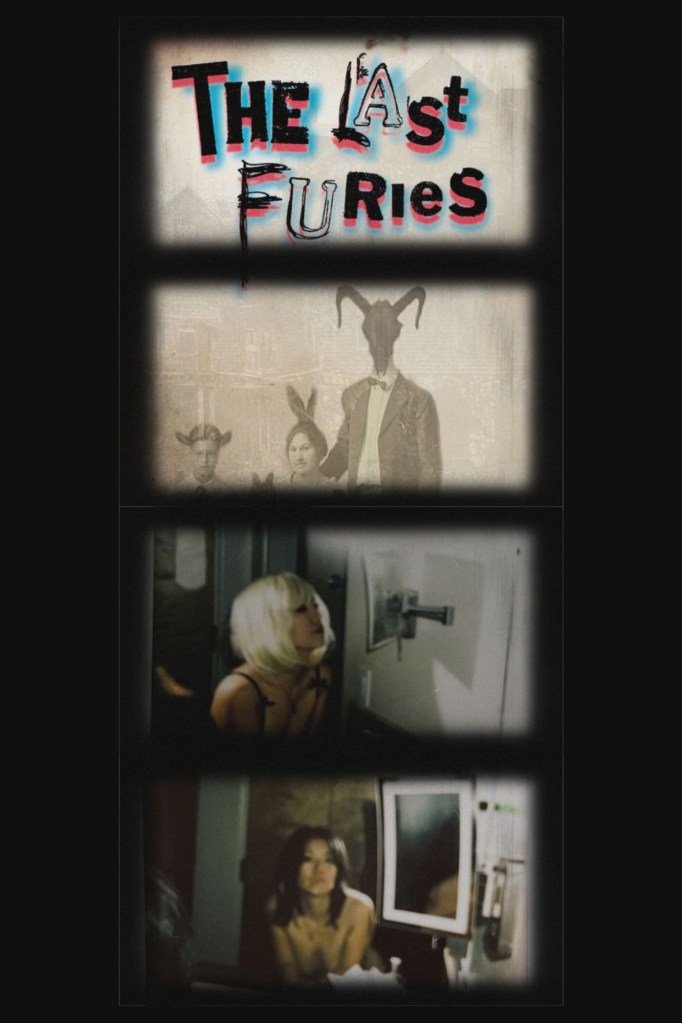
Thank you in advance to Lucky 13 Gallery for hosting what will be a second event for The Last Furies during Martin Luther King, Jr. weekend in January 2026 (the first will take place at Reverie Bookstand on January 17th).

I am excited to reconnect with my creative compadre, Heather Ross, the cover artist for The Last Furies, as the event will feature a reading and book-signing, and a salon-style discussion with me and Heather about storytelling and visual art (and, most definitely, David Lynch, and our shared love for his artistry).

Posted in Artwork, Audio, Books, Cinema, photography, Poetry, Press, Prose, Publications, Theater, Uncategorized, Video | Tagged , , , , , , , , , , , , , , , , | Leave a comment

A Moveable Feast

   The first time I saw Hemingway he was seated at a table on his terrace overlooking the train station. It was raining that day and I was waiting on the platform opposite the terrace. I chanced to look up and saw a man—firm and solid in his movements, sporting a dark push-broom mustache, wearing a white terry-cloth robe—slide open a glass door and step onto the terrace. He removed the newspaper, which was tucked under his arm, and held it over his head to shield himself from the rain as he made his way from the doorway to the table. Later, upon reflection, I found it strange that a man like Hemingway—a bruiser, a tough guy, a man’s man who self-consciously advertised his machismo—would place a newspaper over his head to avoid getting wet. The walk from the doorway to the table was maybe three feet, meaning he would get wet for a second or two—why so careful?

The raindrops fell in slanting dashes, like finely rendered slits in the air. In between these slits, a torn picture composed itself: a man seated at a table, beneath the dome of green umbrella, newspaper fixed at short distance from his face, no sign or emotion of shift in his expression as he scanned the day’s news. Before flipping to a new page, he would ruffle the paper a few times, what struck me an habitual tic. I gazed at this man and didn’t know it was Hemingway until Hadley came out carrying a tray of food, and she made her way from the doorway to the table without covering her head. Hadley, like Hemingway, was wearing a terry-cloth bathrobe, except hers was yellow. She gave her husband a nod and slight smile and placed the tray on the table, as Hemingway set down the pipe he had just started smoking, rose, and pecked Hadley on the cheek. I’m not sure why it registered at that exact moment, but I lucidly understood that it was Hemingway and Hadley who, inexplicably, had wound up out of time and place, and were living in an apartment that bordered the station where I caught the train every day. Seeing the two of them, together, in the rain, on the terrace, gave me a quiet hopeful feeling.

   I savored the scene, as I waited for the train which would take me to my girlfriend’s apartment in the city, if indeed she was still my girlfriend. She had told me that she didn’t know if she could do it anymore, if she wanted to do it, and I told her I understood, and in a way I did, same as in a way I didn’t.  

   Aboard the train, standing, I held onto a pole to maintain balance.  I gave serious thought to my situation with my girlfriend—our situation—and it wasn’t until three stops later that I realized I was headed in the wrong direction.  I had boarded the wrong train on the opposite platform, and was headed not into the city, but further south in Brooklyn.  The right thing to do would have been to get off and transfer to a Manhattan-bound train, but in considering the phenomena of Hemingway and Hadley on the terrace—out of time and out of place—I decided to stay aboard the train I was already on and see what might be waiting for me at the end of the line.  

Posted in Poetry, Prose | Tagged , , , , , , , , , | 1 Comment

Torch Song

   She is there. She is always there, in the corridor. And she is lonely. This much I know. Lonely as a form of cold that you cannot cover with blankets or insulate against with coats and scarves and such. And you cannot wish it away with a lover, or three lovers, or a dozen. It is a different kind of lonely. This is the lonely that comes from wandering in corridors for too long. From living a life, unconfirmed, in corridors.

   That’s where I found her. Or how. Sometimes where and how are the same thing. She was a gauzy corridor that I had walked through. A corridor at once familiar and unfamiliar, eerie and serene. I traversed the length of this corridor, a length that was relative and subjective, and while I sensed that this corridor connected to another corridor, which connected to other corridors (and there must be rooms which factored into this layout), this corridor held me as a country unto itself. A country with a single inhabitant: her.

   She had long dark hair and was of a slight build. Her back was always turned to me, so I never saw her face. She was wearing clothes, but I couldn’t see them. That is, I knew she had clothes on, but for whatever reason they didn’t visually register. It was like I intuited the fact that she was clothed. Only the long dark hair came through as a concrete visual.

   Here’s how it went, every time: She’d walk to the edge of the corridor—me following her, as if magnetized—and she’d turn the corner, and when I turned the corner I’d find that she was gone. Always, exactly, this way. The walking, the turning, the vanishing.

   Ther was a fireplace in the corridor. Sometimes I’d sit in front of it. I’d sit there and luxuriate in its warmth and make up stories that I would never write down or share with anyone else. They were stories meant to keep me company. I understood the loneliness of the girl with the long dark hair. Wishes can burn your eyes out. In one of the stories, that was the moral: Wishes can burn your eyes out.

   Even so, I always wished to see the girl again, walking along the corridor, turning the corner, disappearing. And I did. Again and again. It was like an infinitely repeating poem or song. I don’t know exactly how many times I saw her—walking, turning the corner, disappearing—before realization, like a crystal spike, was driven through my forehead: The girl didn’t disappear. She became one of the flames in the fireplace.

   This became the fourth movement in the sequence. Or, you could say, there wasn’t really a fourth movement, but a revision of the third. Walking down the corridor, turning the corner, and disappearing via transmutation into one of the flames in the fireplace. This changed my relationship to the situation.

   Now, after she turned the corner, I’d immediately teleport to the fireplace (which was much faster than walking) and I’d see her there, a thin dancing flame, red and gold on the edges and pale blue in the center. She was there, swaying hypnotically, in sync with the concert of flames. She was a note, a precious and necessary note in a ritual score.

   That was how I came to understand that her loneliness was a different kind of loneliness from the different loneliness I had originally attributed to her. Her loneliness was a mystery. And a gateway. Through it, music could enter and seed itself.

   What I still don’t know is if she was a flame that became human, or a human that became a flame. Then again, it doesn’t really matter. What is real, and what is true, aren’t always one and the same thing. And now, when I tell stories in front of the fire, I know that she is there, if not listening, then at least dancing, and the company we keep goes beyond words.

Posted in Poetry, Prose | Tagged , , , , , , , , , , , , , | Leave a comment

The Last Word podcast

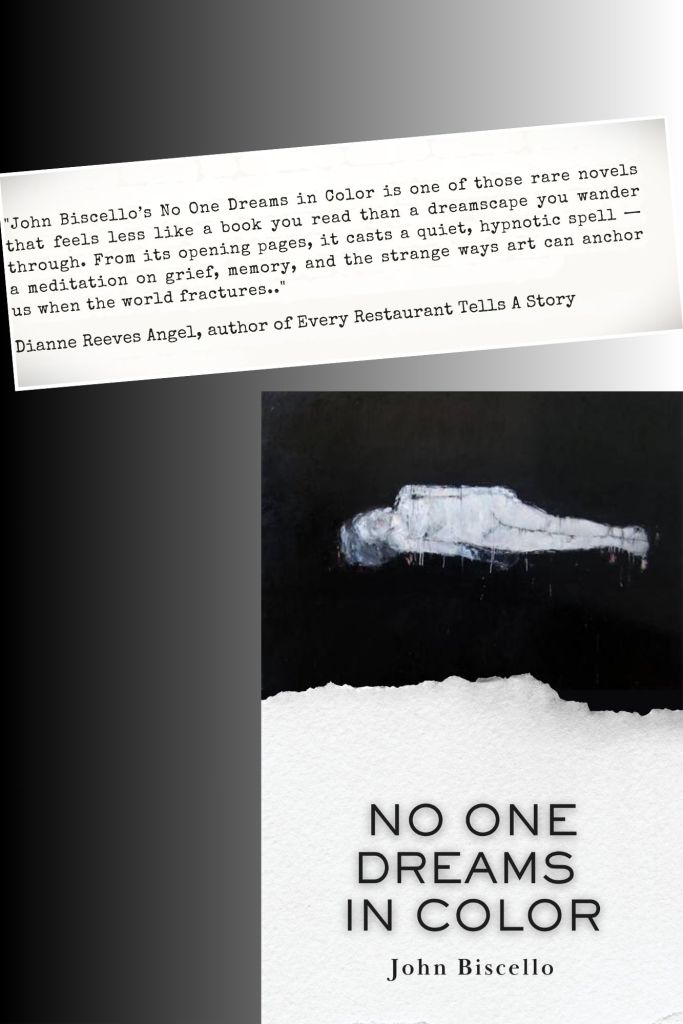
“Fascinating insights into the ‘storied and wild mind’ of author, playwright, poet and performer John Biscello with his latest book The Last Furies. Our far-ranging conversation takes us from his home in the “grunge-wonderland” of Taos to lands of fables and myths and even deeper into lucid dreamscapes real and imagined, awake and asleep. Spending 23 minutes with John convinces me that science fiction writer Robert Heinlein invented the word ‘grok’ to participate in a conversation like this one.”–Carly Newfeld, The Last Word

https://www.ksfr.org/show/the-last-word-show/2025-12-11/12-11-2025-with-john-biscello

Posted in Artwork, Audio, Books, Cinema, photography, Poetry, Press, Prose, Publications, Theater, Uncategorized | Tagged , , , , , , , , , , , , , , , | Leave a comment

City Lights

   There’s something wrong with him, my father said. Look at him. Something’s not right. Something’s happened to him. He’s sick. All he thinks about is writing. That’s all he thinks about. He is blue.

   Even though I wasn’t there, I heard my father. And perversely relished what he had said about me. All I thought about was writing. I was sick. I was blue.

  I took a job at Duane Reade. No one explained to me what my duties were. I just started doing stuff. Mostly I moved around items around on the shelves, trying to look busy. That, and I dusted the shelves. Somehow I was in possession of a feather duster.

   While I was dusting, the store manager asked me if I could work tomorrow night. I tried to think of reasons why I couldn’t work tomorrow night, but just wound up saying—I’m not interested in your offer.

   The manager’s thin dark severe eyebrows jumped to the middle of her forehead.

   Do you even want this job, she asked me.

   I gave it some thought. Yes, I said, but only on a part-time trial basis. Maybe a couple of nights a week. We’ll see how it goes.

   The store manager curtly nodded and walked away. How could she fire me? I couldn’t even remember having been hired. What was I doing at Duane Reade dusting shelves and reorganizing their inventory?

   At one point, I stopped working and stepped outside through the back door. There was a breathtaking nighttime view of the city. Everything was lit up with a resplendence that evoked the nostalgia of old films. It was New York, through a Hollywood lens, in the 1930s or 40s. My heart went out to that city, but the rest of me returned to Duane Reade. I picked up my feather duster and went back to work. I knew that I was between worlds. A decision would have to be made soon.

Posted in Cinema, Poetry, Prose, Uncategorized | Tagged , , , , , , , | Leave a comment

The Last Word

It was a treat getting to chat with Carly Newfeld on the Last Word podcast (KSFR, Santa Fe Public Radio), as we talked about wild mind, inspiration, the richness of solitude and silence, and my new novel, The Last Furies, from which I read an excerpt.

The interview will air on Thursday, December 11th at 5:30pm (ksfr.org, or, 101.1 on local Santa Fe radio), and afterwards will be available to stream on The Last Word archives of ksfr.org.

Posted in Audio, Books, Cinema, photography, Poetry, Press, Prose, Publications, Theater, Uncategorized | Tagged , , , , , , , , , , | Leave a comment

Dark Matter

A story from out of the dark. First there was one voice, followed by a second voice … the dark twists itself into shapes and semblances. The dark is the clothing our ghosts wear. I have tried to acquaint myself favorably with the dark. Intimately. Went so far as to classify the different kinds of dark. I have attempted to grow close to the dark in its all moods and phases. One of my primary concerns as a writer is self. The self lurking beneath persona, the self ceaseless and tagged for void, the self that can never be spoken or written about, hence all this writing and speaking, this insane questing for the impossible, this pipe fix mania and fiendish polka. It is fondling absence on its phantom limb and expecting a warmly felt response. Silence will always have the last word.

Posted in Poetry, Prose | Tagged , , , , , | Leave a comment

Talisman

Wordwise, edges and ledges: we are falling off. We, as in word-wielding also world-wearied, we, an endangered species, parrots with branded larynxes … falling off.

Ask a stranger to cup your balls (male or female you, no matter) as you cough, the stranger playing doctor and nursemaid to your quivering mass of neuroses, your celibate graveyard, as you diagnose yourself a dying breed. So be it. You believe if you say so be it again and again, everything will turn up roses in a garden of manure and Manuka honey. You even go so far as to tell your center—Look, I don’t want any more trouble from you. I’m done listening to your constant moaning and bellyaching … find another sucker to dump on.

What about the words? Ah, the words, our words, many words, have become grossly fattened dodos with albatrosses dangling from their necks. It is a double-bird curse, affliction in the form of gristly feathers amassing in the black of your throat. We are using words as hatchets to bludgeon and bury cause, rhetoric bereft of vision or imagination, blind beggars with candy canes, imbecilically muttering touche to every dropped remark or empty vent. Words that secretly wished to god they were something or somewhere else. Our words have lost their way—highly disturbed and hyper-sensitive orphans adrift in the swimless tides of shifting climates. They have grown dull, palsied, ineffectual, at the mercy of typing void of forethought and hoping to reform through afterwords that never come. Where is the wonder? Can we recall when language itself, its voice and summons, was kin to dreaming? From out of the dark, stories arise. One voice meets two … two meets a burning choir. The dark is the clothing our ghosts wear when animating desire.   

Posted in Poetry, Prose | Tagged , , , , , , | Leave a comment

Intimate Measures

It is a lonely road. The road made of words. The words stay put. The feelings don’t. The words crystallize, become the flambed edges of something soft in the center. It is a struggle within, and a turn-on, mud-wrestling false angels under hot lamps.

In Fellini’s film, 8 ½, the protagonist, Guido Anselmo, the cinematic avatar of Federico Fellini, says—I have nothing to say, yet I am determined to say it.

We mime silence by kissing words on the mouth.

Posted in Cinema, Poetry, Prose | Tagged , , , , , , , , , | Leave a comment